Thursday, December 28, 2017

Greek Electricity Consumption Up Again

One of the best indicators of economic activity is electricity consumption.  It's pretty simple why: activity requires energy, and in modern, services-heavy economies electricity dominates.

The latest data for Greece (Nov. 2017) confirm my conviction that flash 3Q GDP estimates from ELSTAT, the Greek statistical authority, underestimate actual economic growth and will likely be revised upwards, just like the second quarter. 

Electricity consumption for Jan-Nov 2017 is up a very healthy +3.8%. Conversely, ELSTAT estimates real (inflation adjusted) GDP growth for the first nine months at just 1.1%. Such a large difference is too large to be ignored as a fluke, particularly since electricity consumption growth has been steadily higher for the entire year.


Looking into the electricity data in more detail we see that consumption increased most in the mid-voltage sector, i.e. commercial customers such as hotels, restaurants, large retailers and small manufacturers (+7% ytd).  That’s exactly in line with this year's rise in tourism, for example.  Low voltage consumption (mostly households) is also up +3.3%, while at the high end (i.e. industrial customers) there is a drop of -1.12%.

                            Pct. of total consumption    Change YTD
Low Voltage:                    62.3%                               +3.33%
Middle Voltage:               25.3%                               +6.96%
High Voltage:                   12.4%                                 -1.12%
Total:                                  100%                               +3.79%

Tuesday, December 26, 2017

Greek Bank Core Profits

When it comes to Greek banks everyone seems to be stuck on one subject: Non-performing loans.  While this is a very serious issue since bad loans comprise around 45-50% of total loan portfolios, it obscures what is happening under the surface of red ink: strong core profits.

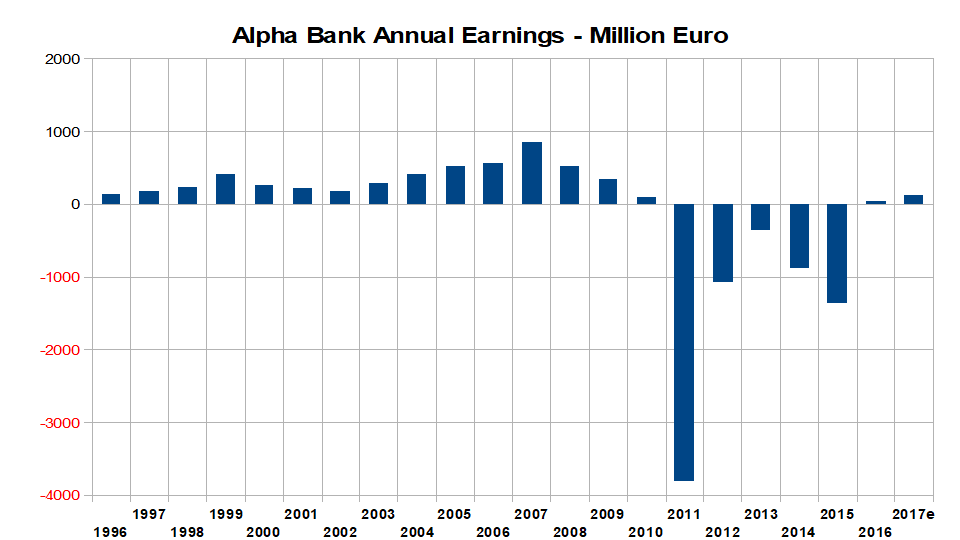
A good example is Alpha Bank, Greece's largest bank by market capitalization (2.47 billion euro as of Dec.23).
 
*2011 provisions exclude losses from the Greek Government Bond haircut
2017e are 9m results annualized

As you can see from the chart, core earnings (revenues minus expenses) bottomed out in 2012 and have been rising since. This year they are likely to reach pre-crisis levels, or even higher if significant mark-to-market gains from its Greek government bond portfolio are included - 2017 has been a banner year for GGBs.  Furthermore, core earnings are now exceeding loan provisions and write-offs, producing net bottom line profits for the first time in six years.  

Profits are driven by high net interest margins and lower operating costs, which are being slashed as the Greek banking industry consolidates drastically. Just four banks now  account for 97% of all banking assets, a level of concentration far above the EU average.

I expect the rise in core profits to continue as the economic recovery gains momentum in 2018-19 and costs are reduced  further by more staff reductions and branch closures.  I also expect to see some top line gains from a slight pickup in credit expansion and the gradual shift of government borrowing from the official sector to bond issuance.  And I would  not be surprised if the capital controls imposed in 2015 are lifted entirely towards the end of 2018, bringing back deposits now hidden under mattresses.

Saturday, December 23, 2017

Santa Rally For Greek Banks?

 Just like in The Night Before Christmas which mentions four reindeer, there are four listed Greek banks (ok there is also a fifth, much smaller one, but I give myself the privilege of poetic license).

On Comet, on Cupid, on Donner and Blitzen! 

Instead of a picture of Santa and his flying present-laden sleigh bringing us all holiday cheer, a chart of a Greek bank with "Christmas ornaments" added by yours truly. All four "reindeer" exhibit similar patterns, by the way.


So... Ho, ho, ho and a very Merry Christmas to one and all*! 

*(Except for you shorting "reindeer": alas, I think you will find a lump of coal in your stocking.)


Thursday, December 21, 2017

Greek Bond - Bill Spreads

Greek government bond yields have come down dramatically in the secondary market during the past few weeks.  Apart from the implied boost in investor confidence, there are also more tangible benefits.

Specifically, Greece has 15 billion euro outstanding in 3 and 6 month treasury bills, rolling over monthly in staggered maturities. Yields for those are also coming down, and are about to drop further.

Taking the 3-month bill as an example, it started the year paying 2.70% and the last auction on December 13 came in at 1.60%.  By comparison, the German 3 month bill is negative at -0.86%.

The driving force for further drops in bill yields is the stellar performance of the 2 year note, which is now at 1.80%, just 20bp above the latest bill auction.


For the last six months the spread between the two has been holding around 100-150 bp, so the next 3 month auction should come in at significantly lower rates. 


I don't expect this spread to hold as high with rates coming down - the equivalent German 2y-3m spread is a mere 15 bp - but it's apparent that the Greek state will be saving at least another 50-100 bp on the cost of rolling over its 15 billion euro in bills, going forward.  It comes to 75-150 million euro annually, a rather tidy sum.

Tuesday, December 19, 2017

Shorting Greek Banks: Don't Be A Fool, Zeus!

Imagine you are Zeus, sitting on your gold and ivory throne atop Mount Olympus at 2.917 meters. Feeling kinda low after yet another day of nagging from Hera, and bored of eating ambrosia and drinking nectar day after day, you decide to head down to the world of mortals for some slumming with the hoi polloi.  Ouzo readily comes to mind..


 Image result for zeus on mount olympus


You can easily turn yourself into an eagle and fly, but what the heck, it's a fine sunny Grecian day so you decide to walk  instead. After all, mere humans climb up and down mountains all the time, how hard could it be for a god? So, you strap on your sturdy walking sandals and head for the path that leads all the way down to the shores of the Aegean Sea.

It's easy at first - the path is steep, but it also means you go down the mountain fast.  After a while, however, the ground starts to level out and the sea glimmers far away in the distance. What you thought would be an easy descent becomes a long slog.  You perspire inside your finely spun silken robes (damn that Helios and his blazing chariot!), you get thirsty and hungry... and not a temple in sight with sacrificial offerings of wine amphorae and grilled meats that you could rightfully claim as your own. You pass a spring of cool water, but gods don't drink water, do they?

After a while, you reach a plateau and go by several herders tending their goats. Being a god - nay, the Chief God! - you are not going to lower yourself to the point of asking for their wine or stale, hard bread, so you slog on unrecognized.  It's now well past noon - you are parched, your lips are starting to crack in the intense heat.  Oh, what you would give for a cup of that nectar now. By Jove, even plain water would do!

After several more hours stumbling on dusty paths, you finally reach the sea.  You may be Zeus, but this is Poseidon's domain and you don't have the power to turn even a small portion of it into fresh water.  Having fallen out with your brother-in-godliness over one of his comely Nereids, you are not about to ask for his help, either.

Lucky for you, an old man comes along and lo! he has a skinful of water hanging on his shoulder.

"You there, old fella, give me your water", you cry out. "I have just come down the Mountain of Gods with not a drop to drink! I am dying (well, maybe not dying..) of thirst".

"Why, sir", says the old man, "I would gladly do so but these being hard times - frightful drought you know - water is expensive. I myself had to pay dearly for it and cannot just give it away for free. What can you give me in exchange? Any gold or silver coins on you?"  

"What? How dare you? Do you know who I am? I could turn you into a donkey!"

"Well, I don't know anything about miracles, sir, as you can plainly see I am just a humble peasant. But I do have water and you are in need of it, quite apparently.  What use would you have of an ass, anyway? Now, that's a really fine silk garment you have on.. and those sandals would go a long way to comfort my poor old feet as I go about the hard roads of Hellas... perhaps we could trade, sir?"

And that's how it came to be that Zeus sold his godly garments for a mere bucketful of water, and ended up having to explain to a smirking flying Hermes how the God of Gods had to be rescued from a deserted beach, buck naked and unshod...

The moral of the story, or the epimythion as the ancient Greeks would call it, is this: if you are gonna sell something, you better do it at the top of the mountain instead of the very bottom.


Greek Ruins: A Delphic Oracle Speaks

I am a great fan of obscure economic statistics because they often reveal more about the true state of the economy than mainstream numbers like GDP.  For example,  the Cardboard Index in the US, which tracks the manufacture of corrugated paper for packing boxes used to ship goods.

As I was idly perusing the Greek Statistical Service (ELSTAT) website I came upon a data series which I had not seen before: visits to museums and archeological sites. The connection to tourism is obvious, particularly for well-heeled tourists who spend more on their vacations than just sun, sea, souvlaki and beer.

 Image result for delphi
Temple of Apollo in Delphi (up 28.8%)

For the period Jan-Aug 2017 such visits are up an impressive 18.8% vs. 2016 and receipts from admission tickets are up even more at 20.3%.  By contrast, tourist arrivals in general are up only 9-10%.


 Now, unlike Warren Buffett, I'm certainly no oracle; yet, I think I can clearly hear the Greek ruins speak... :)

Saturday, December 16, 2017

Greek Bank Wars: Return Of The Jedi

This week Sudden Debt pays homage to the opening of yet another Star Wars episode. The title comes from the third installment released in 1983, but my version is more recent and less galactic.


 ========================================
 
"Greek banks lack earnings visibility."  
"There is no story, other than bad loans." 
"Their balance sheets are shrinking."  
"There are no creditworthy borrowers."

If you are at all familiar with the Greek Depression and its Greek banking saga you have certainly heard one or all of the above.  In fact, up until recently I would be the one saying them - but no more.  I now strongly believe there is a story and strong earnings visibility for Greek banks.

What's new, you ask, what has changed?  To answer that I must first take you back almost a quarter century. In line with Star Wars, let's call it a prequel.


A long time ago in a galaxy far, far away...
 
In early 1994 the Greek socialist government made a seminal decision: it would do everything necessary to meet the Maastricht criteria for membership to the European Monetary Union and its planned common currency, the euro.

One of its first actions came in May of the same year when it abolished FX and capital controls on the drachma. Speculators immediately attacked, betting on a massive  devaluation. However, the Bank of Greece raised short-term interest rates sharply to triple digits and ended the crisis within two months.  Speculators who had shorted the drachma  withdrew with heavy losses. 

What followed was a seven year period of unprecedented prosperity for banks and investors who followed the Convergence Trade: huge profits were made by borrowing foreign exchange at low interest rates (mostly German marks, DEM), exchanging them into Greek drachmas (GRD) and investing at much higher interest rates, either in drachma deposits or high yielding Greek Government bonds (GGBs).

It was a safe bet because the government, acting through the 
Bank of Greece, was committed to a slow and predictable devaluation of the DEM/GRD exchange rate (i.e. a sliding peg) which was always less than the cross-currency interest rate differential.  In simple terms, investors made, say, 12% in drachmas annually and lost only 8% on the gradual DEM/GRD devaluation.  That 4% differential was pure profit.  As time went on this differential narrowed with Greek interest rates dropping gradually and eventually converging to other EMU currencies' rates.  Thus the name Convergence Trade.

D0zens of local and foreign banks rushed in.  Institutions such as JP Morgan, Deutsche Bank, Bank of America, Morgan Stanley, Citibank, UBS, Credit Suisse, HSBC, Merrill Lynch, Goldman Sachs, SocGen, ABN and many, many more were in the drachma market daily. Even the erstwhile Lehman Brothers and Bear Stearns made guest appearances to what was, literally, a "money for nothing" party.. (Well, it wasn't really "nothing": these profits were ultimately paid by Greek taxpayers, the price paid for admission to the eurozone).

Greek banks profited handsomely, too.  At the time when retail and corporate banking was sleepy at best, dealing rooms were roaring.  Some of them exploded from 5  to 50 employees within just two years, as profits soared and bonuses were lavished on one and all.  For several years, over 50% of Greek bank profits came from Convergence trading gains.  

As time drew closer to Greece's admission to the eurozone drachma interest rates dropped and the party finally ended in 2001. Dealing room profits dropped sharply and several foreign banks that had set up shop in Athens shut down and moved on. 

But what about Greek banks?

At the time, Greek bank shareholders were suffering the effects of a punishing bear market on the Athens Stock Exchange.  It was the result of a truly historic bubble that took place in 1997-99, one that saw even mountain goat herders selling their flocks to buy into the craze.  Stocks had doubled, and then doubled again and again... it was madness, until the inevitable crash which started in late 1999 and concluded in 2003.


Apart from the effects of the bubble bursting, banks were suffering from the imminent loss of Convergence Trade profits and a lack of future earnings visibility (ring a bell?).  

As you can see from the charts for Alpha Bank, after first going ballistic, shares dropped as much as 80% top to bottom between 1999-2003. Earnings fell 58%.
   Price of Alpha Bank shares on ASE (split adjusted)


After 2002, however, earnings and share prices recovered strongly as banks focused on retail and corporate lending.  Prior to the euro, Greek households and businesses carried very little debt since drachma interest rates were very high.  Things changed rapidly after 2002, when a combination of Greece's entry to the eurozone and globally low interest rates post 9/11 events made borrowing cheap and easy. Credit expansion ran at breakneck speed, boosting real estate prices and GDP growth.  Shares soared again.

Then the global debt bubble burst in 2007-08.

Greece, facing ever larger budget deficits, and unable to borrow on its own, had to accept bailout loans from the EU and IMF;  its bonds suffered deep haircuts.  Bad loans inundated bank balance sheets (today NPLs and NPEs amount to approx. 50% of all loans), profits turned into losses and banks were re-capitalized three times, with massive dilution to their original shareholders, who saw their investments collapse 99.5%. Balance sheets contracted by 45% in 2010-17 and the industry consolidated furiously. There are now just four major Greek "systemic" banks, accounting for a whopping 97% of all  assets.

 OK, enough with the prequel. 


What is the sequel? Where are future profits going to come from (visibility), what is the "script" for our Greek Bank Wars?

In my estimation Greek banks are uniquely placed to take advantage of two major opportunities:

  • Because of the bailout programs Greek government debt is currently 80% in the form of non-tradeable loans from the official sector - that's 260 billion out of a total 325 billion euro.  With a return to more normal conditions, economic growth and increased investor confidence, Greece will seek to slowly at first and then more rapidly,  swap official loans with its own bonds. The reason is that the loans impose strict oversight rules that restrict fiscal freedom.  Such bonds will initially have attractive spreads over other government bonds and yield far above banks' cost of money, making them ideal profit-generating machines for Greek (and other) banks.  Longer term, Greece will seek to replace at least 75% of loans with new GGBs, because that's the level at which oversight is terminated. That's a very nice business for banks, and for a long time, too.  Think of it as Convergence Trade II, creating earnings visibility for several years going forward.  The convergence has started: 10-year GGBs are now at 3.95% (German Bunds are at 0.30%), the lowest since 2006 and down from nearly 12% in 2016. Two year notes are at 1.95% (German 2-year notes are negative at -0.72%), below even the government's average overall funding cost (approx. 2%). They were at 10% last February.
Historical Data Chart

  • Despite the mess in consumer, mortgage and corporate loans, banks are finally and rapidly dealing with their NPLs and NPEs through a combination of loan sales, write-offs and foreclosures/auctions. By the end of 2019 they will have halved their bad loans.  Such a bitter medicine leaves a lasting aftertaste to lender and borrower alike.  Meaning, Greeks have now gotten a hard lesson in coping with debt and have, at last, acquired a credit ethic. Renewed credit expansion, when it comes, will be based on much firmer ground.  And it will come, because banks' assets are now at just 155% of GDP - or even less, when we adjust for the rapid deleveraging from the bad loan reduction. By comparison, Germany is at 261% and Italy at 248%.
Aha! You say.. Where are banks going to get the money to buy new GGBs and make fresh loans?  After all, they are still borrowing (if less every week) from the ECB's Emergency Liquidity Assistance program, aren't they?
Here's the answer: deposits.  Yes, deposits - those that fled in a panic during the Greek crisis, going to safe havens abroad, in safe-deposit boxes and under mattresses. Banks in Greece held 281 billion euro in deposits in 2009 (122% of GDP) and a mere 144 billion as of this past October (80% of GDP). But, unlike the US Great Depression, Greek bank customers have not lost a single penny of their deposits. Their money is still intact. Even if we deduct foreign depositors from the 2009 figure above, there is a very, very large pool of money that, given the right conditions, will come  rushing back into Greek banks - perhaps as much as 100 billion. 

All right... Just like the Star Wars space opera, this has been a larger post than I normally write. Yet, I think the subject is really worth it.  Since I don't think readers of Sudden Debt need me to spell out the obvious conclusions (you are much too smart an audience), I will leave you with...
May the Force be with you.

Friday, December 15, 2017

Greek Bonds And The IMF (Plus A Note On Banks)

Greek Government Bonds (GGBs) have been this year's fixed income star performers.  In the past 12 months the 10-year benchmark GGB has rallied impressively from 8% to 4.15% as public finances consistently exceed targets and the economy shows signs of solid and sustainable growth.  

A recent bond swap consolidated many smaller issues into fewer benchmarks and added liquidity to the secondary market, prompting more institutional investors to participate.  Most transactions now take place over the counter therefore volume data are not readily available, but the Bank of Greece has its own trade platform where  volume in just the first week of December is already 2.5 times higher than the average monthly volume for all of 2017.


The shorter end of the yield curve has benefited the most from the rally: 2-year GGBs now yield 1.99%, a level that is  below Greece's overall weighted average cost of funding at the end of 2016. 
 

While loans from Greece's European official sector lenders (ESM, etc) carry very low interest rates and have long maturities, the IMF's loan facility of around 11 billion euro costs 3.5% and has a much shorter weighted average maturity, around 2.5 years.  Its maturities are staggered every few months, with the last being in 2024.  

Therefore, it is becoming increasingly possible for Greece to repay the IMF early and lower its annual interest costs substantially, through a carefully balanced issue of new short and medium term bonds (2-5 years).  Total face amount of debt would remain the same, but lower annual interest payments reduces its net present value, resulting in a credit positive event.

Why is this important, if it were to happen?

Firstly, repaying the IMF early is a political decision between Greece and some of its European lenders who see the IMF as Greece's fiscal "policeman". So, even though it would make very good sense from a narrow financial perspective, it may not happen for political reasons.

Still, the very real possibility that Greece can now repay the IMF early and disengage from its rather harsh oversight means that Greece is firmly standing on its own feet, after a decade of tottering on the edge. This is a powerful message to all investors: Greece is back.

A final note concerning Greek banks: for the last few months Greek banks have been haunted by the IMF's thinly veiled threats that it will demand yet another recapitalization (completely unnecessary, IMHO).  Their shares have suffered on the Athens Stock Exchange, some of them falling as much as 50% from their summer highs. Thus, even the possibility that the IMF can now be completely removed from the Greek program acts as a positive factor.
  
The current bond rally also creates substantial capital gains for the Greek banks who own several billion GGBs, and who will mark them to market at much higher prices, significantly boosting their annual profits and/or increasing their ability to write off even more non-performing loans.

I will have more to say about GGBs and Greek banks on my next post.

Wednesday, December 13, 2017

Greece Outperforming The World: Cassandras Beware

If you own a basket of global government bonds during 2017 you have a ho-hum total return so far: a mere +1.60%.  

But if you ignored the Cassandras and bought Greek Government Bonds (GGBs).... oh boy... what a spectacular year: you are now up well over +30%. And if you were even more of a risk taker and bought them back in 2015, you have more than doubled your money.

Yields on the benchmark 10-year GGB are now at 4.35%, the lowest since March of 2008, having plunged from a high of 8% just this last spring and 20% in the troubled summer of 2015. 

Conversely, if you were a Cassandra (alas, I know quite a few of you) and bought uncovered Greek CDS  betting on a collapse, you are now nursing 60% losses - just this year alone.


Now, there is yet another species of Cassandras out there, very much alive and kicking: those who are stubbornly still shorting Greek bank stocks, plus selected other shares like the Public Power Company.

Guys, a word of advice from one who has been through the boom-bust-boom cycle a few times.  You are shorting ... NOW? 

I mean, Greek banks are already down 99+% from their bubble highs and have been through three successive, massively dilutive re-capitalizations... and you are shorting.. now? Where were you when the party was going full swing and everyone was so drunk they couldn't see a shack without thinking it a mansion? Ain't you a bit LATE to the party?

But hey, that's what makes a market...

OK, OK, one last teeny bit of advice for you Cassandras, boys AND girls: the 2-year note is now at 2.09%.  What does this mean, you say? If you are active in the Greek market and you don't understand, good luck to you AND your jobs.  

For all the rest, it means that Greece is now very close to being able to fund itself from the market at a level very near that of the official sector loans (around 2.0%). And, much more importantly, it is rapidly becoming possible to expunge the IMF from the Greek program by repaying its 14 billion loans early - they carry a high 3.5% interest rate.

FYI, Greek government bonds are now at:

2-years: 2.04%
5-years: 3.45%
10-years: 4.25% 

The IMF has been the biggest "thorn" on the banks' side, agitating for more asset quality reviews and - possibly - yet another recapitalization.  Now... what if... well, you get my drift...


Monday, December 11, 2017

Greek GDP Prospects: Housing And Tourism

Understanding Gross Domestic Product (GDP) boils down to just three numbers: consumption, investment (also known as capital formation) and trade balance.  That's it.

Understanding the Greek Depression is even easier, since it boils down to just one number: investment in housing, i.e. new home building.  As you can see in the chart below,  housing construction - the largest driver of investment in the boom years, by far -  collapsed to nearly zero (0.65 billion euro in 2016).  I don't know how far one has to go back to see similar numbers - statistics only go as far back as 1995. If I had to guess, I would say at least back to the 1970's.

Transportation equipment (new car and truck sales) have also come down, while the rest of the sectors are basically unchanged.
 
The chart also points to how the Greek economy may revive. Given that a massive boost in consumption is unlikely with constricted personal incomes, substantial growth can only come from two sectors: construction and tourism (i.e. service exports).

How are things there? There is good news on both.

  • After ten years of constantly dropping (chart below), private sector building permits are finally on the rise.  Year to date (Sept. 2017) the number of permits are up +8.6% and the surface area +16.8% versus 2016.  There are more, and bigger, buildings being constructed in Greece this year.  

  • Tourism is going very well in 2017.  For the first nine months tourist arrivals and receipts were both up 10% and it looks like the fourth quarter is up strongly, too. Tourism is the single largest industry, accounting directly for roughly 8% of GDP and nearly 20% when all effects, indirect and induced are accounted for, so a strong showing there has a multiplier effect on the economy.

Strength in the tourist sector is also attracting capital investment, so we have a rather nice one-two punch going on here.

 
Assuming consumption does not take a dive (unlikely, given the robust increase in tourist arrivals), GDP should show a healthy rise in 2017, gathering momentum for 2018.


P.S.  Interestingly, new car sales are up, too: +21.6% ytd in September.