Friday, April 27, 2012

Update on Quo Vadis EUropa..

The Socialist leader Francois Hollande won the first round of French presidential elections and is now the favorite to win the second and final round on May 6th.  Polls show him leading Sarkozy by a wide 10% margin (55% vs. 45%).  

And if Parisian taxi drivers can be a reliable prediction source, Hollande is definitely going to win (smile)... I was in Paris last weekend and one particular gentleman was a voluble Hollande supporter (oh monsieur, Sarkozy no good pour la peuple, les pauvres, you oonderstaand?).

A Paris...

And if France is not enough, parliamentary elections are being held in Greece on the same day.  For the past 40 years the country's two main parties were used to getting a combined 80-85% of the total votes, counting on graft, corruption and paternalism.  No more: the crisis has stripped them bare and made their horrible mismanagement apparent to everyone;  they will be lucky to get even 40% together.  The Greek Parliament may end up representing 8 or even 10 parties, a unique situation in its modern history (4-5 parties is usual).  

Depending on the total number of parties that finally make the cut (a minimum 3% is needed for entry), anything from 5 to 7 of them will be either on the extreme left (there is still a Stalinist Communist Party in existence) or the extreme right (a fascist fringe that used to poll 0.2% is now showing up at 5%).   Not a happy turn of events, because all of them want Greece to get out of the eurozone, one way or the other.

The point is this: If France and Germany don't see eye to eye on practical matters very soon (say, by June), then the EU will fall apart for want of a cohesive substance more than the hot air constantly emanating from Brussels.  

What this may be?  A firm commitment to a common fiscal policy.  I can't emphasize it enough: a common monetary policy is nonsense without a common fiscal policy.  One-legged creatures can't run.

Friday, April 20, 2012

Quo Vadis, EUropa?


France holds the first round of its presidential elections this Sunday and Greece has scheduled  parliamentary elections for May 6, coinciding with the second and decisive round for French elections.  In France the Socialist candidate is the frontrunner against the incumbent conservative Mr. Sarkozy, while in Greece popular sentiment is hugely against the entrenched two-party system that so obscenely mismanaged the country for the past four decades. (Germany will hold its federal elections in September 2013 - or earlier under certain circumstances).

Is a likely political shift in two countries enough to steer the EU towards a new direction? Perhaps it is. France is, by far, the second most important nation in the Eurozone (and perhaps number one from a historical EU perspective), while Greece is currently undergoing history's largest debt restructuring.

 Where are you going, Europe? 

And what direction could this be? Well, in my opinion, there are only two possibilities:

a) The Eurozone falls apart, to be followed shortly by the breakup of the EU itself.
b) Europe's new(?) leaders finally realize that a monetary union without fiscal and real political union is untenable, so they take bold steps to unite the EU in fact.

I believe that no sane European wants the first choice - there is just too much at stake to give up.  The last seven decades have seen the longest period of uninterrupted peace in Europe for many, many centuries;  remember that the EU was established chiefly to avoid future wars and not as a means to create efficiencies of economic scale.

It is not pleasant to watch Europe going through its current pains.  Hopefully, however, they are birthing pains and the result will be a better, more truly united  Europe.


Monday, April 9, 2012

It's Been A While...

This is the first post in some months... but it's not that I've been away or extraordinarily busy.  Rather, I've been "digesting" all that has been happening around the global debt crisis, particularly in Europe.

There's no need to analyze the eurozone's debt woes - this is a horse that has been beaten to death so many times already, and by so many informed, misinformed and "deformed" commentators,  that I feel I have nothing original to add. 

Instead, I will once again revert to my oft-repeated thesis: that this here "debt crisis" is but a symptom of a wider, more virulent disease, and that by focusing on it, rather than trying to confront its deeper causes, we are making things that much worse for ourselves and our children.  What good does it do to provide daily doses of aspirin to a patient with pneumonia?  Yeah, the fever will go down, but the patient will eventually die.

And this is exactly what we have been doing... at least, that's what my stomach is saying after "digesting" the news for these past months.  So... It's the (real) economy, stupid!! .. is today more apropos than ever before.  Politicians, economists and even "smart" businessmen are constantly looking for monetary fixes (i.e. liquidity) to what is a fundamental, paradigm-shift problem.  Earth to Everyone: It can't be done.

Look at Europe's scape-pigs: Portugal, Italy, Greece, Spain... but also Ireland, the UK - even France (and Germany won't be far behind once China dips).  Everyone is mired in doom and gloom and the (real) economy is going absolutely nowhere.  Austerity, reform, restructuring, debt forgiveness... it has all lead to precisely.. nowhere.  Unemployment is very high (23% in Spain, 22% in Greece, etc etc) and still rising, earned income has tanked, productive investment has collapsed... I can go on and on.  But in one word, the real economy absolutely sucks (pardon my french).

We desperately need a serious Paradigm Shift.  Quit stroking the bankers and start stoking the fires - or, rather, start spinning the windmills, laying out the solar panels, drilling the geothermal wells, building the electric economy...

It almost doesn't matter what, but the when must be NOW.


Tuesday, December 20, 2011

Debt Issuance: Boom to Bust

A short post today.

First of all, may I wish everyone a very Merry Christmas and Happy New Year.

Secondly, a rather interesting chart (click to enlarge) from the Bank of International Settlements (BIS) latest Quarterly Review.


Global Issuance of Debt Securities Has Collapsed

The global boom of floating trillions of new bonds in 2007-08 has - predictably - become an out and out bust this year, as the credit crisis takes a knife to the appetite for more debt. Notice that the amounts in the charts are net, i.e. after accounting for maturities.  

Despite all the talk of massive sovereign bailouts, the figures show that there is very little increase in the total amount of debt outstanding.

Monday, November 28, 2011

Debt of The Financial Sector

Here's a scary chart, one that I believe explains why the current Debt Crisis merits capitalization, and why it won't go away easily - certainly not by merely "printing" money and giving it to the FIRE sector (finance, insurance, real estate).

 USA:  Financial Sector Debt Soared Sixteen-fold Between 1952 and 2008


In a most dramatic way, the chart shows that in the United States debt issued and owed by the financial sector (banks, insurers, brokers, etc.) soared to nearly one third of all debt outstanding.  A similar pattern is observable across the entire Western economy.

The process gathered steam between 1995 and 2005 because of:

(a)  financial speculation (leverage, derivatives, etc) and,
(b) securitization of all manner of bona fide and financially engineered loans, from mortgage debt and credit card receivables, to CDS hybrids (CMO's, CDO's, CPDO's, etc).

The end result was the financial/debt/monetary bubble that burst spectacularly in 2008 - and is still bursting, since the shadow-banking bubble machine has not been shut down.
It is, therefore, highly ironic that the Debt Crisis caused by a virulent out-of-control financial sector has now infected the once safest haven of them all: government debt.  Bankers, brokers, money managers and rating agencies - whose inter-connected behinds were collectively rescued from self-immolation three years ago - now lash out at the very governments whose deep pockets (a.k.a. taxpayers) saved their bacon.


Italian Government 10-Year Bond Yield

Putting it another way, the massive expansion of finance and its subsequent collapse is suffocating the world's real economy.  We need hundreds of billions of fresh capital to invest in productive projects like energy and network infrastructure, but the FIRE sector is demanding (blackmailing?) that governments continue to dump good money after bad down a bottomless pit, one dug by their own greed and perfidy.

Of course, governments are not innocent babes in this operatic auto-da-fe.  First, they foolishly deregulated finance, a notoriously self-serving, risk-loving and cyclical business (for example, by abolishing the Glass-Steagall Act).  And then, they kept looking the other way while finance mutated and morphed into a menacing giant, albeit one with extremely weak legs.

It is high time that governments act decisively and forcefully to reverse the "financialization" of the real global economy.  We cannot survive, never mind thrive, on the "free-markets" mantras of  Wall Street and City alone.    The FIRE sector must be forced to de-leverage.

There are many ways to do this: higher capital requirements, strictures on own-account trading, transaction taxes, regulating off-balance sheet derivatives.  In my opinion all of them, and more, must be implemented.  The purpose is as simple as it is difficult: Kill the beast before it kills us.


Thursday, November 17, 2011

Is There Life After Debt?

Fact: The debt crisis is global - and, yes, this includes the so-called creditor nations, such as China.  After all, in our fiat currency world it takes a debit in order to create a credit.  

The way we got into this mess is well known: the West foolishly (even criminally, if you ask me) gave up its industrial/manufacturing base and the high earned-income jobs it generated, replacing them with services and low value-added jobs.  However, it didn't lower its consuming and spending habits to balance the losses, instead it piled on debt from vendor nations, and constructed Rube Goldberg asset bubble contraptions that attempted to generate "wealth" out of thin air (e.g. real estate, derivative-based bonds, etc.).


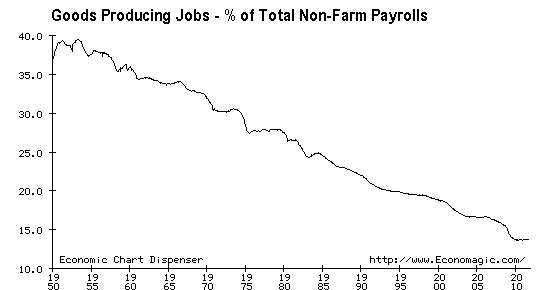
 Anyone Still Making Anything in the US?

As the chart above shows, the process of de-industrialization is not new, at least not in the U.S. where goods-producing jobs have fallen steadily over the last 60 years, from 40% to 13.8% of total non-farm payrolls.  As a direct consequence (in my opinion) wage and salary income has dropped from 68% of total personal income to just a little over 50% (see chart below).

Earned Income Has Dropped Drastically

Consequently, total debt soared to 550% of earned income - even excluding debt of the financial sector (see chart below).


 Can The Real Economy Sustain This Debt?

This chart raises one very important question: can the real American (and Western) economy sustain its debt load, or will it collapse under it? To put it another way: Is there life after debt?

The answer to this question involves much more than quantitative easing, classical econometric ratios, or Tea Party dogma.  We must go straight to the heart of the global " Permagrowth" economic paradigm, the one we have been using and abusing for well over a century.  In this outdated and obviously crumbling model, debt and growth are intrinsically linked, one becoming the enabler for the other in a sort of pushme-pullyou perpetual motion machine.

But it can't go on. Debt is a call on tomorrow's growth - and if such growth is impossible then the debt becomes untenable. The Earth's diminishing resources, benign climate included, can no longer sustain Permagrowth, therefore we cannot repay or even adequately service the immense debt/credit loads we have created.

Yes, there is life after debt.  But it will be very different from the consumerist Shangri La we had become used to.  I believe we are headed towards a low-intensity, decentralized type of macro-economic paradigm where energy and most consumer goods are produced locally from renewable sources, and where the sociopolitical system is likewise decentralized.

The important question is this: can such a paradigm shift be accomplished relatively smoothly and peacefully, or will it take a major upheaval? I really don't know..

P.S. On the eurozone: Dear Mrs. Merkel (or is it Ms.?), when your entire neighborhood is on fire it is not a good time to argue the bad structure and poor management practices of the Fire Department.  Rather, please make sure the firemen have plenty of water and leak-proof hoses.

Sunday, October 30, 2011

Ninety-Nine Percent

In the last 30 years the top 1% of Americans saw their real, after-tax  income increase nearly fourfold. And how about the "other" 99%? Look below (click to enlarge)...


One picture is worth a thousand words

The chart appears in an article in The Economist (Income Inequality in America:The 99 Percent), which includes the following passage:

...the data are powerful because they tend to support two prejudices. First, that a system that works well for the very richest has delivered returns on labour that are disappointing for everyone else. Second, that the people at the top have made out like bandits over the past few decades, and that now everyone else must pick up the bill.

Couldn't have said it better myself (and I don't frequently agree with The Economist).


The chart in The Economist article comes from a very interesting study done by the US Congressional Budget OfficeThe following chart is on its cover.


Friday, October 21, 2011

The Battle For Europe

From all the news flow out there it appears to me that we are nearing a so-called "inflection" point in the European debt crisis.  After a summer and early fall of spinning wheels to no end, European leaders are faced with a stark choice: finally do something serious, or watch the entire euro structure fall apart with unimaginable consequence for the European Union as a whole.

There is a eurozone summit meeting this weekend, to be quickly followed by another one three days later on Wednesday.  If the Franco-German axis (no, I do not use the term lightly) does not reach a mutually satisfactory agreement on Greece, expanding the EFSF and bank recapitalization then the inflection will point straight down.

The Battle for Europe is, tragically, being fought by generals who are well out of their depth.  They created a continent awash in funny money and a population that for decades felt entitled to their comfortable - albeit debt financed - lifestyle. Oh yes, even the holier than thou Germans;  I mean, how else could  those "other" Europeans afford to buy millions of BMWs, Airbuses and Miele washers exported by Germany if not through debt?  It's not as if Kalamata olives or jamon Serrano have much value-added, after all. And vacations in Terremolinos, Rhodes or Costa Brava are on perennial all-inclusive, cheapest-is-best  offer...

 Let's Hope It Doesn't Come To This, Again

Europe desperately needs a whole new cadre of strong and decisive leaders who will turn things around.  Maybe the current ones will see the light and pave the way for them by gracefully bowing out, after taking whatever steps are necessary right now to forestall implosion. But, I'm not holding my breath..


Thursday, October 6, 2011

SNAPpy? Surely Not.

I occasionally look at the US Dept. of Agriculture data on food stamps (now called Supplemental Nutrition Assistance Program - SNAP) because, in my opinion, it provides a much better "on the ground" feel of the real economy.

It certainly doesn't look snappy.
Data: USDA SNAP

As of July 2011 a record one in seven Americans, or 14.5% of the country's entire population, was receiving food aid.  That's far above the 9% mean over the last 30 years.

Steve Jobs

Steve Jobs, the co-founder of Apple, died yesterday, age 56.  He was one of those very few people who changed the world for the better and who will always - and uncommonly - be remembered with admiration and fondness.

Have a Beautiful Trip Steve