Tuesday, June 28, 2022

The Twilight Of Empire

The early part of the 20th Century saw the concurrent collapse of four empires and the rise of another to supersede them all. The British, Czarist Russian, Austro-Hungarian and Ottoman empires became victims of WWI, and from their ashes rose the global might of the United States.  Its pre-eminence was briefly challenged by the Axis powers during WWII and the USSR during the Cold War, but they all shattered under the overwhelming might of the American economic juggernaut.

America originated as a loose gathering of opportunists, but it found cohesion through a visionary political system and revolutionary Constitution, both designed by its brilliant Founding Fathers.  In the absence of common culture, religion, history, or even a common language, the nation was built entirely upon a common set of laws and a unique balance of power among the three Estates. It worked well, until the deeply unequal prosperity between the industrializing North and the agrarian South led to the Civil War. Its aftermath made industrialization the new norm and rapidly created what has held America together ever since: the common prosperity of its mighty, upwardly mobile middle class.

It was the astonishingly rapid rise of this prosperous middle class that begat the myth of the American Dream. Mind you, I’m using myth in its Ancient Greek interpretation  of  mythos, ie a morality tale, and not today’s meaning of “unreal story”. The American Dream was, however briefly as History goes, a very solid reality evident in the high living standards of most American households. Rising from the abject poverty of late 19th Century city slums to the detached homes of 1960s suburbia, America’s middle class was mythical, indeed.

The common prosperity of the middle class is now gone.  I won’t produce statistics as proof, though I certainly could;  all I need to mention is MAGA as the Presidential race slogan - emphasis on Again. So, if not a common prosperity, what’s left to keep the Nation together?  Why, the original glue, of course: the Constitution and the balance of power between the Executive, Legislative and Judicial Estates. How are they holding up? In a word, terribly.

  • Starting from the Constitution, the three most recent Supreme Court decisions on guns, abortions and public school prayer clearly show that the Court has completely lost touch with society and become highly politicized - even downright partisan. Our society depends on laws that keep pace with the times, not literal interpretations of codices and scriptures written eons ago. 
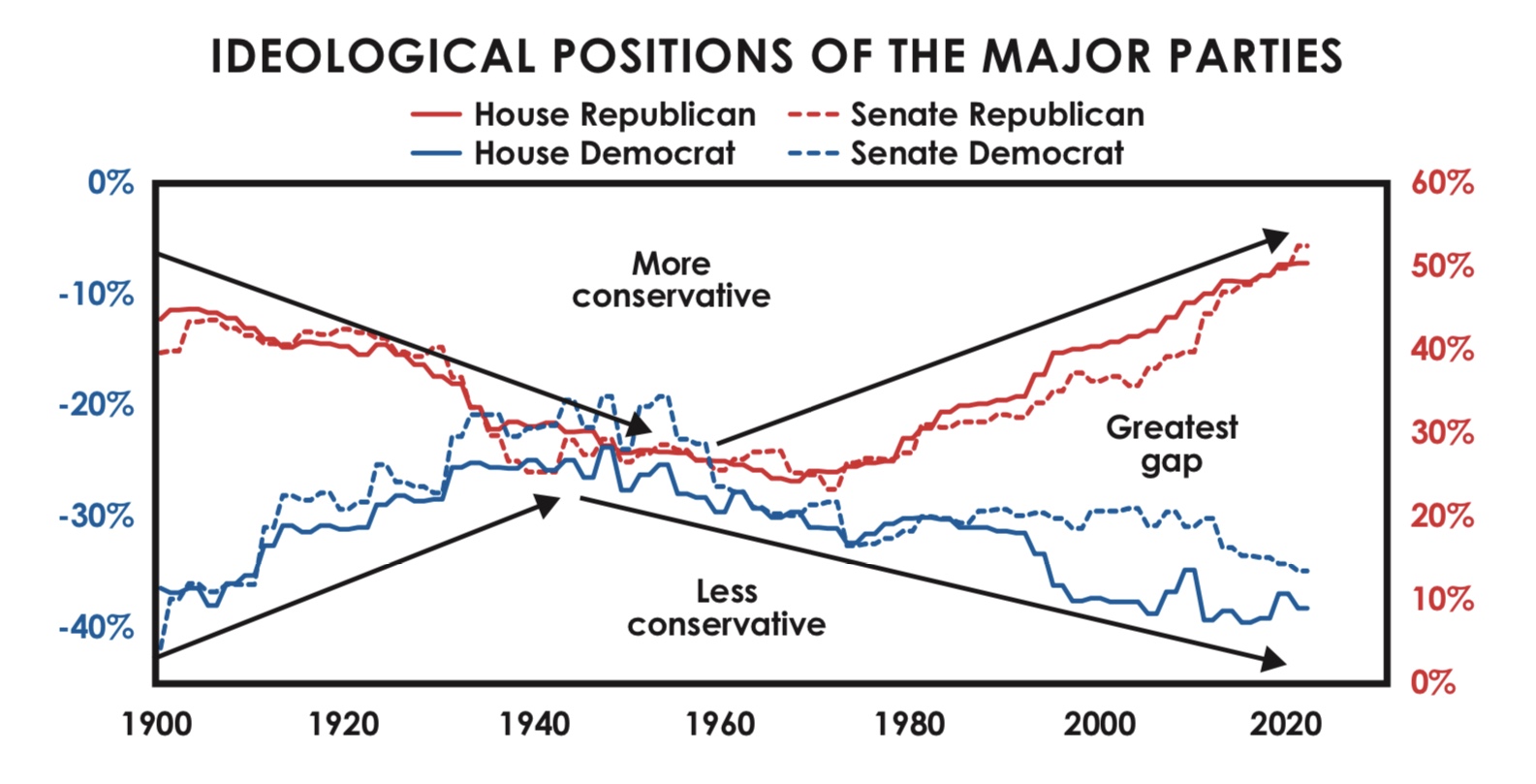
  • The Legislature is polarized in the extreme (see chart below, from Ray Dalio), and has no parliamentary traditions to create workable consensuses. America’s political system is winner-take-all, unlike in Europe where multiparty governments are the norm.
  • The Executive branch has become increasingly imperial. Following almost precisely the ancient Roman timeline, Reagan and Clinton were as Julius Caesar and Augustus, our Tiberius is a combination of Bush and Obama,  and Trump is our very own Tweeter-manic Caligula. And he  has been succeeded  - just as in Rome - by the old, feeble, stuttering Biden as our Claudius. It seems that US history is suffering from Imperial Repetition Syndrome.
  • The Judiciary is still doing ok, I guess, but even there landmark decisions on socially sensitive issues follow political lines.  There is always more publicity around SCOTUS, but there are hundreds of significant decisions from State courts, and they show a marked influence by politically powerful lobbies.

My conclusion, sadly, is that America's Empire is on the wane.  To paraphrase, "it's twilight in America".

Saturday, June 25, 2022

Real Earnings Crashing Through The Floor

When the data changes faster than the scale which measures it, you get the chart below.

Crashing through the floor, the real (inflation adjusted) earnings yield of stocks is at a 70 year low. I’m almost certain it is an all time record low, too, I just don’t have a chart going back to the 18th century.  


The fundamental question is, can companies raise prices for non-essential goods and services faster than their input costs? Can they raise prices faster than wages? Can they raise their earnings faster than inflation? IMHO, no way. 

Thus, we all better be prepared for much lower P/Es going forward.


Friday, June 24, 2022

Inflation: Expectation vs Reality

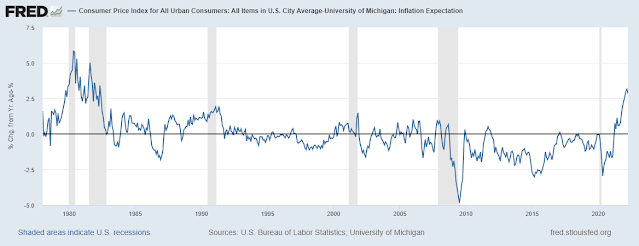
The University of Michigan publishes monthly surveys of year ahead inflation expectations. Right now, people think it will be at 5.4%, well below today's 8.60%.  The chart shows this expectation (blue line) and current inflation.  It's a pretty good fit, for the most part. If anything, people are more conservative in their predictions than reality.


In the next chart, I look at the spread between current inflation and prediction - see chart below. It is now at the highest level since 1982, ie people are still predicting/hoping that current high inflation (8.6%) will come down fast.  But, the last time people's predictions were this optimistic (1980s) they were proven dead wrong as inflation soared to near 15%.

Only time will tell what will happen, but for now I'll go with "hope dies last".

Thursday, June 23, 2022

Inflation Fear Grips The Nation

Just came across these charts from the Michigan Survey of consumer sentiment.  

I'm used to vertical take-off charts, but this is stunning, even for me.  Americans must be scared out of their minds about inflation, with their mood swinging violently from utter complacency to strong concern in a manner of weeks.  

Another chart from Michigan shows the fastest ever deterioration in financial expectations, particularly among males.

My conclusion is that consumers must already be stepping hard on the spending brakes for anything other than essentials. Latest data on the charts are from April 1, 2022, by the way.  

Wednesday, June 22, 2022

Risk Premiums Still Low

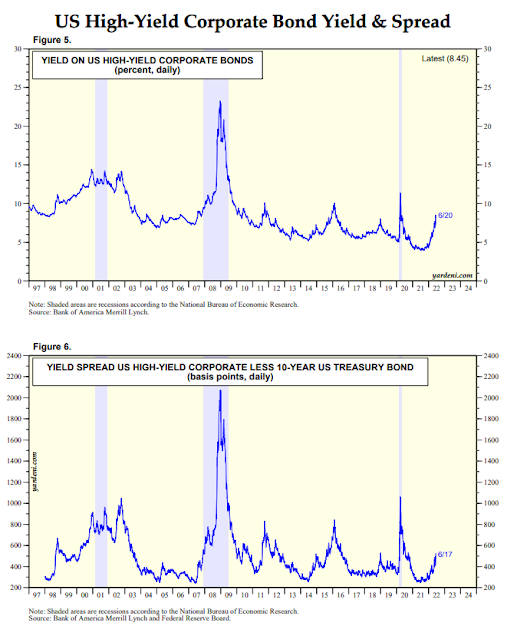
Risk premiums are a common way to assess where we are in the economic cycle or, more accurately, where the market thinks we are.  Premiums bottom out when the economy is strong and top out at the bottom of a recession.  Right now, the spread between returns on high yield bonds and 10-year Treasurys is rising, but it is still very far from previous cycle highs.  Meaning, investors are still not worried about a significant recession that would lead to corporate bankruptcies.

The charts below from Yardeni Research make things quite clear: excluding the Great Debt Crisis of 2008-09 which saw spreads rocket to over 2000 bp (20%), spreads usually top out around 800-1000 bp (8-10%).  Today, spreads are still only at 500bp.

Another way to look at it is this: with junk bonds yielding just 8.45% and inflation at 8.60% a junk investor is not being compensated at all for assuming the extra credit risk.


Tuesday, June 21, 2022

Chart Gazing - Nasdaq Composite

It is rare to find "picture perfect" technical chart patterns, and I'm always suspicious of them when I do.  But, sometimes, a cigar is a cigar.  Without further comment, an annotated chart of the NASDAQ Composite index.


Monday, June 20, 2022

Quantitative Tightening

I know I sound like a broken record. But on the subject of the Fed and ECB as inflation fighters, I shall repeat my mantra: It's the QT, the QT, QT - and not just interest rates.  

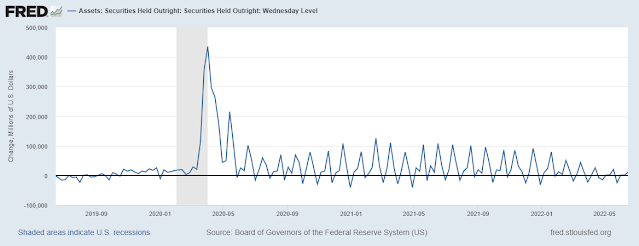
Money, and everything else that trades from microchips to potato chips, has TWO measures: quantity and price.  Interest rates are the price of money, money supply is the quantity of money. Central banks are responsible for regulating both, not just interest rates.  Particularly since they went bonkers with Quantitative Easing during 2020-22.

The chart below shows the weekly change in the Fed's balance sheet assets - at one point it was adding $400 billion of fresh money per week!  It has since eased off, but it is still adding and not subtracting liquidity to the system.

Therefore, I will know that the Fed is serious about combating inflation ONLY when the line on the chart dips well below zero and stays there for the duration.


Markets are still focusing almost entirely on rate hikes.  No one I know is even thinking about QT as a factor that will affect the market.  But as we saw a week ago in the Italian and Greek government bond markets, the ECB's pause in buying their bonds sent their yields rocketing upward, and panicked politicians immediately pressured Mrs. Lagarde into promising some sort of "tool" to protect the hapless South.  It is still unclear what she will do and what effect, if any, her "tool" will have.


Italy Government Bond Yields Rocket Upwards

Sunday, June 19, 2022

Crypto: Crash And Consequence

To paraphrase, nothing exceeds like excess.  In March 2020 the total market value of all cryptocurrencies was $141 billion.  Less than two years later, in November 2021,  it had exploded to almost $3 trillion, a 20-fold increase that was part and parcel of the “everything bubble” created by the printing presses of the Fed and ECB.

As expected, cryptos are now collapsing faster than any other “market” segment. Speculative frenzy has been replaced with fear, FOMO (fear of missing out) has become FOLIA (fear of losing it all).

Will the Crypto Collapse have consequences beyond its own backyard? Yes, of course: not only will it freeze risk appetite for everything (crypto has become a sort of mania weathervane), it will also create a cascade of cross-collateralization margin calls for all financial assets.  The crypto market capitalization at $3 trillion was just too big and juicy to ignore as a source of collateral to carry other positions in stocks, commodities, etc.

In a hypothetical case, a speculator who owned crypto worth $1 million could have used it as collateral to buy stocks worth as much as $1.8 million (90% crypto margin, 50% stock margin) - that’s leverage of 1.8X.  Worse yet, the $900.000 from the crypto loan could be used as margin to buy stock futures, thus raising the leverage to 14X.  But, it could be worse still: instead of futures, the wild-eyed speculator could buy CFDs (Contracts For Difference) where leverage can be as high as 50X.  

It is all somewhat reminiscent of the derivatives’ alphabet soup in 2004-08, where huge leverage also wiped out hundreds of billions in “value”, initially starting from pools of speculative real estate and its associated mortgages.  

The underlying, entirely false, assumptions for crypto and junk mortgages were  the same: real estate mortgages don’t default, and crypto is just as good as cash money in the bank - or even better. The reality is that they were both highly speculative trading sardines.  

The crypto collapse is a catalyst accelerating events on the downside, so I won’t be surprised if I hear that some big names are caught in it.  El Salvador comes to mind…. I mean, can you just imagine? An entire country bought trading sardines, won’t  there be at least a few big institutions out there that bought them too? Or, as Warren Buffett puts it, as the tide recedes we will find out who’s been swimming without a swimsuit.


Saturday, June 18, 2022

Watch What I Say, Not What I Do

These are truly weird times. In fact, it is the only time in my memory that it makes more sense to pay attention to what people are saying, instead of doing. Allow me to explain.

On the first chart we see that consumer expectations are at a record low, on the same level as the dark days of 1970s double digit inflation, the 1987 Crash and the Great Debt Crisis.  Notice how Americans’ expectations dropped during the pandemic and then recovered slightly, only to plunge to the bottom immediately after, despite the trillions showered upon them by the Government/Fed.


And showered by trillions they were, indeed.  Household financial assets jumped by an incredible $30 trillion in a matter of months, the largest increase in the history of the United States - see chart below. The country’s entire annual GDP is approx. $25 trillion, so it’s as if all of it - and more - went into peoples’ pockets as cash and financial asset appreciation. That’s absurd - or rather, absurdly sudden and very, very dangerous.

Household Financial Assets Soared

Americans became InstaRich (or felt like it), and naturally acted like it, spending with abandon. After a brief collapse during the pandemic, retail sales exploded upwards.


Retail Sales Explode 

If there ever was a case of “watch what I do, not what I say” this would be it, right? Yes - up to now. 

Because, things are now getting seriously ugly at the consumer inflation front, hitting Americans very, very hard where it hurts most: housing (mortgage rates have doubled), energy and transport (gasoline, electricity, heating and automobile prices are up 30-50%) and food (up 15-20%).  Things are also getting very ugly at the stock market and cryptos, the unfortunate choice of many amongst the younger generation who have not experienced bubbles and their eventual sad outcomes. 

So, this is why I think we should pay attention to what Americans “feel”: when people ultimately (soon?) combine their record low sentiment with present market ugliness destroying their InstaWealth, and then act on it,  we may very well get a sudden denial to spend on anything and everything. We may also get a sudden rush for the markets’ exits in order to preserve whatever wealth can be preserved. 

Bottom line: It is weird in the extreme to have record high household wealth, record high retail sales AND record low consumer sentiment, all at the same time.  This situation will normalize, and it could do so  abruptly - thus the dangerous part.

A final note: how is record low sentiment and record high wealth even statistically possible? I believe there is only one possible explanation: sentiment is measured for 330 million Americans, but wealth is concentrated at the top 1% of the population.  In other words, the Gilded Age in extremis. Can the 330 million affect the wealth of the top 1%? You better believe they can, when they stop buying high-value, high-margin “unnecessary” items and services,  and also stop being the marginal “top-of-the-bubble buyers” of stocks and become the “get-me.out.now” sellers. 


Thursday, June 16, 2022

Some Perspective On The Fed Rate Hike

 The Fed raised rates by 75 basis points yesterday (0.75%), and the media focused on it being the "biggest increase since 1994".  Sounds like the Fed is really fighting inflation, right?  I think some perspective is necessary, before we start applauding...

As always, a picture is worth a thousand words:


CPI Inflation (blue), 2-Year Treasury Yield (green) and Fed Funds (red) 

You will be excused if you can't quite see the Fed Funds line today, because it has barely budged from the bottom, despite that "biggest increase since 1994" (ok, it should be a smidgeon higher at 1.50-1.75%).  But, ok, the market is already discounting a couple more rate hikes, to about 3.50% - that's the green line, the yield on the 2-year Treasury, often used as a proxy for where Fed Funds will be in 12 months.

Last time inflation was at today's levels, Fed Funds and the 2-year were both at around 8%.   Can it happen again? Well, unless inflation cools off immediately to 5% or less I can't see how we can avoid it. Thus, the trillion(s) dollar question is, will inflation cool off immediately to 5% or less?  Honestly, I cannot see how it can happen, without persistent quantitative tightening (QT) and a significant, demand-destroying recession.

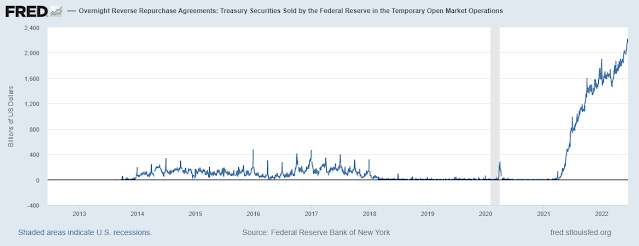
Banks and large institutional investors, ie those who have access to the Fed's reverse repo facility (an overnight deposit to the Fed collateralized with Treasurys), are voting loudly with their money.  The reverse repo amount now stands at $2.16 trillion, a new record, as money seeks the safest haven possible from credit and interest rate risk.

Reverse Repo Amount Soars To Record

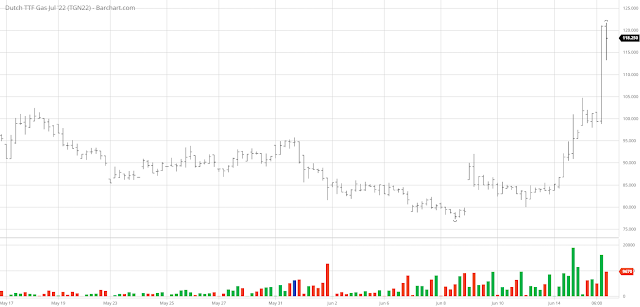
===> And just as an aside, European Natural Gas prices soared to 118 yesterday, up from 85 a couple of days ago, as Russia announced it will cut deliveries through the Nordstream pipeline by 30% "to repair compressors".  Prices were at 18-19 a year ago.  No, I don't think inflation is going away any time soon.

European NatGas Price Jumps