A one question post today:
- Given its enormous debt load and the spike in interest rates driving debt service closer to unsustainable levels, which is in the US government's interest?
It is not because things are difficult that we do not dare, it is because we do not dare that they are difficult.
A one question post today:
I don't think most people realize the massive losses that have been suffered by bond investors in the last year and a half - take a look at the chart below.
30-Year Treasury Bond Prices
The US 30-year Treasury bond was at 156 points as recently as January 2022 (and as high as 180 in mid-2020); today it has collapsed to 118. Ignoring the 2020 COVID-induced high, bond investors are suffering a staggering mark to market loss of 25% in just 20 months. This is not a loss normally associated with the presumed safety of Treasury bond investments. Even worse, it has happened fast - it is the sharpest price drop since at least 1977.So what, you may ask? Bonds are the preferred investment for banks, insurance companies and pension funds. They usually make up well over 70% of their portfolios, one way or another (eg home mortgages are regularly packaged into long term pass-through securities such as Ginnie Maes). And while such investors may choose to place long bonds into their "investment/hold to maturity" portfolios, to shield them from having to recognize mark-to-market losses in their books, that's just an accounting trick.
Reality, however, can never be avoided for long. Rating agencies are already downgrading US banks, for example. Given the persistence of inflation, pension funds are coming under uncreased pressure to raise pensions, particularly government entities. And insurance companies must be worried about more natural disaster claims as global climate change is occurring much faster than anyone thought. All of that means that traditional bond investors may have to sell positions in order to meet liquidity demands.
And I haven't even touched on the subject of much higher borrowing and refinancing costs for governments and businesses. In brief, the entire world had become grossly and unhealthily addicted on ultra-low interest rates for the past 10+ years. It is now discovering that money is not free, or even cheap.
Those of us who are, or were, active in the professional/wholesale side of markets (eg interbank) know very well that bond markets lord over all other markets. The daily trading volume of the US bond market is simply enormous: just amongst primary dealers daily volume averages around $750 billion for Treasury securities alone. Add the rest of the participants, corporate and muni bonds, throw in repo and you're up to well over $2 trillion changing hands every day. Compare this to the US equity market at around $200 billion per day and you get the picture.
Therefore, what goes on in bonds is extremely important, not only because interest rates are paramount in our economy but also because size matters! - and it matters alot.
Bonds are now looking rather worrisome. Take a look at the yield on 30-year Treasurys - chart below. At 4.44%, the yield is at, or very near, 12 year highs. I don't care what equity analysts say, the real pros are sending us serious warning signals.
US Treasury 30-Year Bond Yield
The thing that is truly worrisome, from a long term perspective, is that bond prices have broken down from their very long term up channel going back 40 years - see below. If you are a chartist - and many pros are - this chart looks scary. VERY scary.
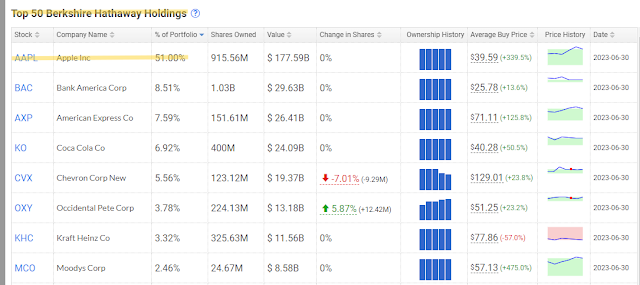
Berkshire Hathaway, Mr. Buffett's primary investment vehicle, has investments in 56 publicly traded companies. Yet, just one (Apple) makes up a massive 51% of its holdings by market value. Another seven make up an additional 34%, for a total of 89% (see below).
So, Berkshire is essentially a proxy for Apple, plus a very, very few more stocks. OK, so Mr. Buffett is not bound by the usual rules for portfolio diversification... but still... WHY has he decided to turn Berkshire into such an incredibly NON-diversified investment vehicle?
Honestly, I don't understand it. Can any reader please comment?
Thanks!
Inflation has come down fast from its highs… but! It’s all due to sharply lower energy prices - see chart below. If it wasn’t for energy (ie oil prices tumbling) inflation today would be at 5% or higher.
When I have nothing better to do, I cast a technical analysis eye upon markets. It's voodoo stuff, mind you, but here goes...
Yesterday, S&P 500 initially cheered the "better than expected" CPI number and rose strongly, only to reverse and close flat on the day (see chart below). Such intraday reversals, particularly on the back of positive news, indicate underlying selling pressure: investors who wish to unload long positions quickly take advantage of the fleeting buying demand and sell into strength.
And now, back to our regularly scheduled program :)
Sometimes all it takes is a picture or two.
Oh so much can be explained about inflation, stock prices and housing by a quick glance at the charts below: assets on the balance sheets of the Fed and ECB.
Just in case you're not 100% percent familiar with monetary matters, within just a few months the Fed printed $5 trillion and the ECB 4.5 trillion euro.
Enough said... but please note that they are currently attempting to drain the oceans of cash, albeit ever so slowly.
Yesterday Fitch downgraded US Federal debt to AA+. Everyone in the administration and many economists attacked the decision as baseless, curious, etc.
But, one chart says it all (see below). US debt as a percentage of GDP is now at wartime levels and has been climbing steadily for decades. Not good...
I just read an article about the reasons why inflationary pressures persist despite sharply higher interest rates. Nowhere in the article did I see the one and only real reason for inflation: Money (duh!).
I mean, here it is in its simplistic form:
In the entire economy...
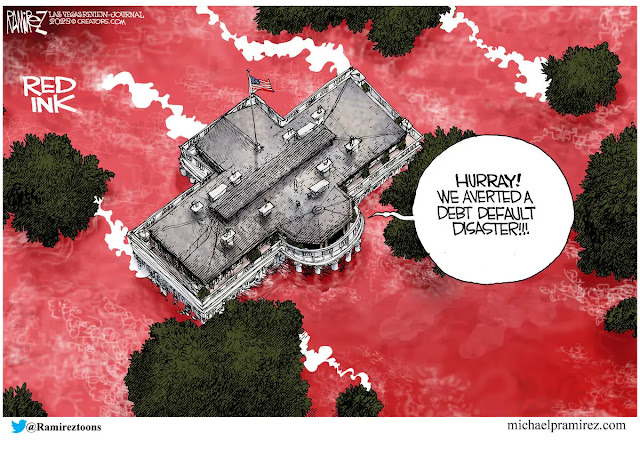
So, the US has (once again) averted going into default. Good news? Sure, on the face of it... but...
Is this what should be the headline news for the world's largest economy? For the issuer of the global reserve currency? For the world's largest debtor? That it averted bankruptcy?
Hmmm... let me think about it... NOT?????