Thursday, December 6, 2007

CDS Factors In Equity Valuation - Part D

This is the fourth in a series. Parts A, B and C were posted on Sep. 10 - 12 and Dec. 3, respectively.

I wish to express my appreciation for all comments and suggestions made by readers of the first three parts; they were invaluable.
______________________________________________________________

Part D: The Equity Risk Premium as Insurance Premium

It was shown previously that Credit Default Swaps are in fact insurance contracts and not bona fide swaps. Taking this insurance characteristic further, let's view the entire CDS market as a large insurance company (CDS Inc.) underwriting credit default insurance on the following entities:
  • Global Governments
  • Global Structured Finance
  • Global Corporations
We need to dispense with the first two, since we are examining the effects of such insurance on equities, i.e. the corporate sector. Before we can do so, we must estimate what portion of the total CDS business is attributed solely to the corporate sector. (If you don't care for the gory details, I estimate it as 80% - now go to Step 3).

Step 1

We can safely assume that central government credit represents only a small portion of the default insurance business. The largest government debt issuers in the world (US, UK, Germany, France, etc.) are themselves rated AAA and serve as risk-free benchmarks. The sole exception is Japan, which carries a AA- rating; it is highly unlikely, however, that hedgers and speculators are much interested in underwriting or purchasing CDS on Japanese government bonds (JGBs), given the extremely low nominal interest rates (e.g. the 10-year JGB is currently at 1.56%). The rest of the world's governments simply do not issue so much debt as to make a difference. In sum, I estimate that no more than 5% of CDS notional outstanding is against central government credits.

This leaves regional/municipal debt. In the US, by far the largest issuer of such bonds, this market is estimated at $1.7 trillion, spread among 50.000 separate entities that issue bonds (SIFMA). This is a market where credit insurance has been dominated by the monoline insurers (MBIA, AMBAC, FGIC, etc.), long before the advent of CDS. It is pretty much an end-user investor market, meaning that there isn't all that much speculation going on. With the exception of a few large issuers such as the States of NY, NJ, California and Florida the market is highly fragmented. This, in effect, limits the use of CDS to mostly hedging purposes and it is unlikely that notional CDS outstanding exceeds the face value of muni bonds, or approx. $2 trillion - if that much. This represents less than 5% of global CDS, bringing the total for all government-related credits to ~10%.

Step 2

Next is structured finance, i.e. credit insurance written against CDOs, CLOs, etc. The total size of the asset-backed market is ~$2.6 trillion, with new bond issuance particularly heavy during the last 2-3 years. For credit insurance, this was also a hedging-related activity until rather recently, when speculation on the sub-prime MBS market created significant short selling interest, particularly against the ABX and CMBX indices. There is no way of knowing with any degree of certainty what multiple of face value is covered by CDS - but we do know that banks have been taking large, multi-billion losses on their portfolios of such paper, so it cannot be very large. Goldman is apparently an exception and so are some hedge funds who called this market right and benefited accordingly. I will go ahead and guesstimate the amount at ~$5 trillion, or another 10% of notional CDS.

Step 3

This brings the total for the first two sectors to 20% of CDS notional, or $9.1 trillion, leaving 80%, or over $35 trillion, as CDSs written against global corporate names. The US Office of the Comptroller of the Currency in its latest survey found that US banks' positions in credit derivatives ($12 trillion) were broken down as follows: 73% investment grade - 27% sub-investment grade (chart below). It can safely be assumed that this split is pretty much the same across the entire CDS market.


Let's revert now to the original premise, that CDS Inc. is one very large insurance company writing all this coverage, 80% of which is insuring the credit, or business risk, of Global Corporations, Inc. We know that current credit spreads for investment grade corporations are approx. 80 bp (CDX IG) and for sub-investment grade approx. 450 bp (CDX HY). The weighted average for the market is thus 170 bp, or 1.70%. However, this is likely too high because we must subtract the far less risky government credits and GSEs included in the 73/27 split given by OCC. With all the estimating going on everywhere, I will reduce this rather arbitrarily to 150 bp, as representative of the entire "book" of corporate CDSs.

If you are still with me...bravo. There isn't much more left to go.

Step 4

So, the annual GROSS insurance premiums changing hands for the entire corporate CDS market is 1.50% of $35 trillion, or $437.5 billion per year. Think of this as the annual premium paid on a contract to cover the risk of holding Global Corporations Inc. securities. The present value of such a contract for 5 years, discounted at 4.40% (the 30-year Treasury rate) is $2.3 trillion. If we view the CDS market as perpetual, then the present value rises to $10.5 trillion.

It is thus possible to argue that these sums represent the amount of risk that has been shifted from the global cash equity market onto the CDS market, thus making stocks appear less risky, or cheaper. Equivalently, we could say that total capitalization and P/Es for global markets are being understated by the equivalent amount. At the end of June, the total market cap of all major stock markets (i.e. stocks of corporations that are most likely to be covered by CDS) was approx. $47 trillion, therefore CDSs created an over-valuation of anywhere between 5% and 22% for stocks. While theoretically we could choose the 5% that represents the expiration of CDS insurance within 5 years, in practical terms it's more proper to view CDS as a perpetual market, adjusting instead for amounts outstanding.

The bottom line is that global shares may now be approx. 22% overvalued, due to the effects of the CDS market alone.

Again I will close by saying, please do take as many shots at this as you see fit. Comments can only help.
________________________________________________________
P.S. Correlation between S&P 500 and US credit spreads


Wednesday, December 5, 2007

The Trigger Man Wore A Suit

Before I continue from yesterday's post about the "debt gun" I would like to offer a short comment about this story making the rounds:

The Fed is looking for ways to entice banks to borrow from its Discount Window and thus ease the "liquidity crisis" currently taking place. They believe that lowering the Discount Rate will shrink the gap between it and Fed Funds and therefore remove the stigma attached to borrowing from the Window, i.e. directly from the Fed.

This is a fallacy.

The stigma - which is very real - is related to having to use the Fed as lender of last resort, not the interest rate. If a bank has to borrow from the Fed, it means its peers in the interbank money market don't want to lend to it, i.e. its credit is no good amongst the professionals that know it best. In other words, it's in trouble.

Certainly, I am not referring to using the Window on an occasional basis because of some last minute liquidity need - that's perfectly OK. But if a bank has to borrow considerable sums from the Fed on a regular and extended basis... it's in trouble, period. Bankers know this and that's why they avoid the Window like the plague.
The Fed officials are aware of this, of course; the fact that they are trying to entice banks to use the Window is a sign of how concerned they have really become. It confirms what we all know already: we are facing a full blown credit crisis and not a mere shortage of liquidity.

I will repeat: Mr. Bernanke is erroneously using 1929-32 as his model, or at least he's interpreting it erroneously. He's trying to start a fire during a rainstorm by lighting one match after another (i.e. cutting rates) and wonders why they are snuffed out by the heavy rain.

I respectfully submit that Mr. Bernanke first needs to get an umbrella.
___________________________________________________________

And now, we return to our regularly scheduled program...

Continuing from yesterday's post:


Who were the trigger men that held a debt gun to the American family's head? Who caused prices for "assets" like a college education, housing and medical care to rise, whilst keeping wage increases to a minimum?

It all started with the neo-liberal economists of the Thatcher - Reagan era, who initiated the process of decimating wage income by attacking labor unions - by then rather easy targets who had disgraced themselves by acting as Big Labor. To be fair, the neo-lib actions should be interpreted in context: The Cold War was still in full swing, leading to ideological clashes between "capitalism and freedom" a la Milton Friedman vs. the "socialist nanny-sate" of the Eurosclerotics. The Chicago School theorists were heavily influenced by their understandable revulsion for totalitarianism and planned economies, echoes of which were reflected from Nazi Germany to the nominally socialist Soviet state. Their intentions were good, but their teachings ultimately became bound by ideology, i.e. dogma.

And with dogma came dogmatics who could not see past their noses, buried as they were in the literal interpretation of their masters' theories: laissez-faire, individual responsibility, freedom of choice, unfettered markets - they were all interpreted in extremis, not contained by common sense. Soft-drink companies were allowed to install vending machines in schools, in exchange for money that was cut from their budgets. Markets were deregulated... and deregulated... and deregulated, until Enron got its hands on the electricity grid and black-outs occurred in California's cities more frequently than in Mogadishu.

Employment experienced a radical shift. Lower level workers were turned into versions of disposable salaried contractors, while the top filled with a caste of itinerant managers whose only concern was to hit their stock option targets. And why not? Milton Friedman had already proclaimed that the only social responsibility of business was to increase profits.

So profits increased.

After-tax corporate profits as a percentage of GDP have now grown to an all-time high (see chart below). Because a very small percentage of Americans own stock directly or indirectly, the benefits accrue to a very narrow segment of the population, greatly widening income disparities. More money is being made, but fewer people are getting it. Bill Gates walks into a bar and everyone turns into a multi millionaire - on average.

Data: BEA

But that's not the whole story, because it wasn't the entire corporate sector that made such record profits. Rather, it was the financial industry that made out like bandits (see chart below). They saw their share of GDP quintuple, whereas non-financials only recently managed to recoup amid the general rise in profitability.

Data: BEA

In the past 25 years profits of the financial sector went from 25% of total corporate profits to 50% (see chart below), a condition frequently called the "financialization of America". Lending and shuffling money around has become by far the biggest business in America, even eclipsing that perennial target of the populist press, the oil companies.


Aha! you may point out: Think of all those jobs the finance industry creates. Good jobs, highly paid jobs - heck, even the secretaries at Goldman make triple figure bonuses - and they are members of the B&T crowd, not Greenwich debutantes. But you would be wrong; because, according to the Labor Department, of the 41.5 million new private sector jobs created in the US since 1980, only 3.5 million were in financial activities. The entire financial industry today employs a mere 5.4% of all Americans working in the private sector, even less than the 6.6% in 1980. Those fat bonuses are going to very few people, after all.

By contrast, during the same time period the leisure and hospitality sector added 7 million jobs and retail trade 5.1 million. Those two sectors account for some of the lowest-paid workers in America, i.e. waiters, hotel maids and store attendants and their combined share of total private sector employment increased from 22.8% to 25%. More people are making less money than before.

Most people get employed where they can, not necessarily where they want: if GM lays off tens of thousands, the next job for a skilled machinist is unlikely to be at another car factory. Some go straight from the shop floor to tending bar. In the last 30 years GM has reduced its workforce in the US from 600.000 to around 100.000. What are people supposed to do? Slash their wrists? Or get a home equity loan to meet expenses, while working at a job that pays 50% less with no benefits, hoping things will improve?

Schumpeter fans will by now be thinking: creative destruction. True, very true. The only problem is that good jobs that were destroyed in America were replaced by good jobs (relatively speaking) in China and India, whose vast pools of peasants turned into factory and service workers. In a globalized economy, there is nothing that cannot be done equally well in China, India or both, at a huge discount. Not even securities research, as some investment bank employees are discovering to their dismay. In the meantime, what are Americans (and Europeans) supposed to do? Borrow, spend and hope the theoretical benefits of globalization materialize before the repo man comes.

Was there a Grand Conspiracy to create debt slaves in America? No, I don't believe so. But the profit motive as a sole driving force in business was more than enough - and stupid in the extreme. Any fool of a manager can increase profits for a short period of time - all it takes is a sharp axe and a dull conscience. We see now what happens when we let loose a whole pack of smart operators and financiers upon the US economy offering them billions, if only they boost share prices from X to Y.

We have bamboozled ourselves into hiring trigger-men in suits to "rub out" entire sections of the economy, selfishly thinking that they will only "hit" the other guy. Well... guess what? We are ALL the other guy.

Tuesday, December 4, 2007

The Smoking Debt Gun

The reason why so few good books are written is that so few people who can write know anything - Walter Bagehot (1826-1877).
Then again, there are those few who do know something and do write good books.

You may have noticed the new "Readers Recommend" link on the right, above the "Hellasious Recommends" list. Many readers suggest excellent books (and videos) in the comments section; it would be unfair for me to take credit by including them under my own recommendations, so I made this new link available to showcase them more properly and fully.

Please feel free to make recommendations and I shall make every effort to include them, given space and time considerations.

H.
________________________________________________

I have frequently (an understatement) pointed out that what is needed to get us out of the mounting debt crisis is more earned income, not more or cheaper debt. The chart below clearly shows how we got into the current mess: since the early 1980's earned income grew ca. 3% annually, while household debt grew much faster (click to enlarge). In order to maintain the lifestyle familiar to them as citizens of the richest and most powerful nation in the world, Americans had to borrow.

No one put a gun to their heads, of course... or did they? I believe someone did, and even pulled the trigger. Let's look for the smoking gun, then...

Data: FRB

I mentioned college loans a couple of days back ("The Bobby McGee Moment"). The college I graduated from now charges $45.000/yr for tuition, room, board, books and fees. Add everything else, and a student and his parents are staring at $50.000 per year minimum. By comparison, my freshman year there cost ~$8.000; that's a compounded increase of 6.30% per year. This is not an isolated case: as the chart below shows, tuition inflation has been running at double the official CPI rate for decades. More importantly, as we see from the first chart, it is much higher than the rise in wages.

Tuition Inflation in the USA (Chart: FinAid)

In the case of a college education, therefore, the smoking gun is quite obvious: tuition and related costs grew so much faster than earned income that parents and students had to borrow. The same can be said of at least two other major expense items: housing and medical care. In the past 25 years the median price of a single family home rose at a compound rate of 6%; medical care services by 6.5% - both much more than wage earnings. How could a family cope with such cost increases vs. their earnings, if not by borrowing?

As could be expected under the circumstances, saving evaporated - there was simply not enough money left over to save. After hovering around 10% for 15 years between 1970-1985, the personal saving rate commenced a relentless drop that brought it all the way down to zero. It even turned negative for a while, an occurrence of dis-saving not seen in the US since the Great Depression.

Personal Saving Rate (Chart: FRB St. Louis)

Certainly there were many people who went overboard: cheap and easy debt allowed them to engage in conspicuous, extravagant consumption. I do not need to repeat the stories... But I think they are the exception, not the rule. When the history of the Great Debt Bubble is told many years from now, they will be footnotes to add color, not the story itself. Because, as Robert Heinlein wrote: People who go broke in a big way never miss any meals. It is the poor jerk who is shy a half slug who must tighten his belt .

The smoking gun that forced American families into debt has been identified: rapidly rising costs for big-ticket essential items like housing, medical care and education, even as earned income grew by much less. So who pulled the trigger and who are the (multiple) victims? That's the topic for tomorrow's post.
___________________________________________________________

Totally unrelated P.S. : Abby's Baaaa-ack.

Abby Joseph Cohen of Goldman Sachs and 1999-2000 stock bubble infamy, just came out saying that the S&P 500 will climb to a record 1,675 by the end of 2008, extending the longest stretch of annual gains since the 1980s.

She is one of the best contrary indicators in the strategist camp. Back in 2000-01 I made a point of shorting every time she came out with a bullish hoo-hah. I think she stayed bullish until 2003 and then turned bear. Just in time.

Monday, December 3, 2007

CDS Factors In Equity Valuation - Part C

This is the third in a series. Parts A and B were posted on Sep. 10 and 12, 2007 and should be read in conjunction.
______________________________________________________________

Part C: CDS Pricing and Implications

We have seen in Parts A and B that CDSs create phantom equity exposure and that their notional amounts have soared to $45.5 trillion as of June 2007, approximately 80% of global equity market capitalization (the chart below updates that appearing in Part B). In this post I shall examine the pricing of CDS and the implications for equity markets.


There are several indices that track corporate CDS: for US corporations the banchmarks are Markit's CDX Investment Grade (CDX IG) and CDX High Yield Indexes (CDX HY). For Europe, the equivalents are iTraxx Europe and iTraxx Crossover. Below are longer- and shorter-term charts for these indices.

Quarterly Review - 9/2007

The shorter-term CDX charts are provided below; the equivalent for iTraxx look almost exactly the same and in the interest of less clutter they are omitted.


CDX Investment Grade (USA)


CDX High Yield (USA)


Source: Markit


As we saw in Part B, CDS pricing is a reflection of the price of the "phantom" shares created by the multiple issuance of CDS and is thus directly correlated to the equity risk premium (RPi) that was presented in Part A. In other words, RPi is a function of CDS risk, expressed as interest rate spreads.

Therefore, from Part A, the price-to-earnings ratio for shares is expressed as:

PE = 1/(RPi + Real Yield) (Equation 3)

We can separate the risk premium RPi into two components:

RPi= RPih - RPic
(Equation 4)

where:

RPih = the value of RPi calculated without the effect of CDS, e.g. as was before CDS amounts took off.

RPic = that portion of equity risk premium that is included in CDSs and which is now trading separately in the OTC credit default market.

This means that the current Risk Premium in the cash equity market appears lower than was the case just 2-3 years ago, leading to higher cash equity valuations, all other things equal.

The creation of CDSs transferred a portion of equity risk from the stock market to the CDS market. Given that, at least theoretically, the total equity risk premium should remain the same, we reach the conclusion that, where sizable CDS markets exist, we can no longer view equity pricing in isolation but must also take into account the CDS market.

This is no easy task for the general public: the CDS market is OTC and dominated by just a handful of market-makers. As of the second quarter of 2007, within the commercial bank universe overseen by the Office of The Comptroller of the Currency (OCC) there were approximately $12 trillion notional CDS outstanding, one third of world-wide total at the time. Five banks held 100% of these positions, with three holding 91%. These figures do not include investment banks, who are also very active in CDS, but provide an accurate view to the concentration within this market.

For the most part, the CDS market is opaque to the general public, though the creation of the CDX and
iTraxx indices has helped provide information about the broader credit default market. Even so, the indices also have a small number of market makers (e.g. 16 for CDX). Again, just a few out of this number account for the majority of pricing and transaction volumes.

There are significant consequences to having the equity risk premium trading in two parts. Because of the explosion in CDS notional amounts and daily volumes, the part of a stock's "value" that is trading in the unregulated CDS market is growing in size. How much that is, is beyond the scope of a mere blog posting and is more properly a matter for further study by academia (if it isn't already).

From the perspective of a market participant, however, I have the following closing observations:
  1. It is possible that equity portfolio investors are still disregarding the effects of the CDS market in pricing shares. This would lead to higher, but erroneous, theoretical valuations (P/E's) for shares in the stock market.
  2. Equity underwriters and exchanges are heavily regulated in order to safeguard the public interest. By contrast, the CDS market is largely unregulated, even though it clearly "issues" and trades phantom equity equivalents in a large primary and secondary market . Unlike regulated derivatives markets (e.g. for listed index futures and options), there are no reporting requirements, no position limits and no uniform margin regulations for CDS.
  3. The small number of major CDS market-makers raises questions about dominant positions and their effects on cash equity markets.
This is a work in progress. I am not an academic, so there are clearly gaping holes in the above analysis. For example, CDSs could also be priced as put options - what does this mean for the equity market? If any reader has suggestions on any of the above, please be so kind as to leave a comment or two, which could be included in a possible Part D. I thank you in advance.

In closing, though I have drawn some overall conclusions about the equity/CDS price relationship which I believe are valid, I have not been able to come up with a mechanism to quantify the effect, e.g. how many S&P 500 "points" are trading separately in the CDS market? The quest continues...


Sunday, December 2, 2007

The Bobby McGee Moment

Commenting on yesterday's post about Mr. Bernanke's combating the current economic weakness with obsolete strategies and weapons from the Great Depression, edwardo had this to say:

THE problem isn't liquidity, or access to credit, as such, though they are problems, the problem is a fatal loss of CONFIDENCE.....
What is occurring now is a watershed event, multigenerational in nature that has the potential to shake what is left of the U.S. republic to its foundations....

The words "confidence" and "multigenerational" combined in my mind to produce a "what if?" moment. Naturally, I take all responsibility for tangential excess and Edwardo is thus not to blame for what follows, if you think it unworthy. But if you think it valuable, the credit is his.

____________________________

What if the current generation of Americans lose confidence in the "system": financial, political and social? Americans are saddled with enormous debt, many of them from the get-go when they graduate from college and are supposed to spread their wings, fly free and start building a better world. Instead, many have a monthly student loan payment around their necks - and I don't have to elaborate on what happens soon thereafter: car loan, credit card, mortgage, HELOC.. everyone is familiar with the "debt slave" rote. Household debt has never been higher in the United Sates, and servicing it now takes a larger percentage of disposable income than ever (chart below).

Debt Service as Percentage of Disposable Income (Chart: FRB St. Louis)

I frequently have a picture of the average, young middle-class American spinning inside a hamster wheel, hoping that with furious running he/she is going places. To keep them running, there are pictures of some wildly successful young hamsters hung around the cage: a hamster.com billionaire, an alfalfa hedge-hog trader. But the wheels are all connected to dynamos producing wealth for the cage-owner class and very little trickles back inside the cage as sunflower seeds and nuts for the common hamster.

What if - for whatever reason - the hamsters decide they have had enough of this running around? What if they refuse to power the wheel, lay down on their cotton-wool beds and watch Critter TV all day long, content to just munch on whatever is thrown in?

Debt is a two-way moral civic obligation. It's not enough for borrowers as individuals to accept their responsibilities for repaying their debt. Society's political, business and financial leaders must also ensure that the economy generates plenty of earned income, so that borrowers have enough to repay debt and improve their living conditions. If, instead of more income all that is available is even more debt, then borrowers feel cheated and the social compact between them and lenders ultimately breaks down.

History teaches that when debt obligations become onerous, society's confidence about the future is diminished. People may just reach a "Bobby McGee" moment and decide that freedom's just another word for nothing left to lose and stop paying off their debt because they see no way out, anyway. No bankruptcy lawyer, no attempt to salvage anything, just... repossess the house, repo the TV, repo the SUV. A p a t h y.

I think the latest scheme by Paulson and the banks to freeze re-sets on ARMs is an early warning that the "elites" are getting really and truly scared about exactly such an eventuality, and are attempting to create a glimmer of hope amongst the "hamster" class. I wonder what Janice would have to say if she was still among us...

Saturday, December 1, 2007

Deja Vu: Fighting The Wrong War

Most generals prepare to fight the previous war.
_____________________________________________________

Chairman Bernanke must be having a serious case of deja vu. He is living through what he researched as a professor: the economy is slowing down from a housing collapse that is spreading to money markets and consumer spending. And just as he concluded in his research of the Great Depression, he is simply not going to allow it to enter a recession - or worse - for want of plenty of cheap money.

I have no quarrel with Mr. Bernanke's analysis of what happened in 1929-32. It was a gross mistake for then Treasury Secretary Andrew Mellon to assert “liquidate labor, liquidate stocks, liquidate farmers”. But easy money is not the way to correct today's problems.

Just like the many generals who are prepared to fight the previous war and therefore lose the next one, Mr. Bernanke is acting based on his analysis of what happened over 75 years ago. He wants to combat the negative consequences of excess liquidity by creating even more liquidity, even more debt. I believe this is a serious mistake, for two main reasons:
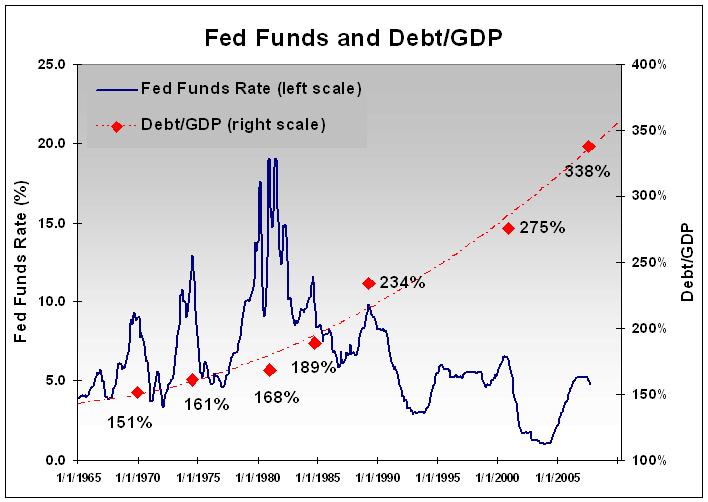
  • The US economy is already so awash in debt that dropping interest rates isn't going to stimulate much more borrowing and spending. The chart below shows the level of total debt to GDP at points of previous major Fed rate cuts (click to enlarge); currently it is almost 340%. With credit spreads now rising, excess debt cannot accelerate the economy. Debt is part of the problem, not the solution.
Data: FRB
  • With consumption making up three quarters of GDP, the US economy is certainly not suffering from too little consumer demand.
The major challenges facing the US are not cyclical, but structural. There is an element of hubris on the part of the Fed, in presuming that it can resolve these problems through monetary policy. For example, lowering interest rates does not relieve earned income compression for the middle class, neither does it necessarily drive investment towards the required "hardware" projects, like energy and environmental infrastructure.

Without spending more time in front of a screen - it is the weekend, after all - I will conclude with this: the Fed cannot solve anything. The best it can hope to do right now, is to avoid being part of the problem.

Friday, November 30, 2007

Further On CDS

Yesterday's post on Credit Default Swaps (CDS) generated considerable discussion. There are a few points that should be expanded.

POINT ONE

Despite their name, CDSs are not swaps, but insurance policies.
This is not merely a philosophical argument about names, as the following will make clear.

First, let's look at a real swap - for example, a foreign exchange forward swap.
This is how it works:

On Date X
Bank A sends to Bank B 100 million dollars
Bank B sends to Bank A 67.567 million euro

So far, this looks like a spot USD/EUR foreign exchange transaction taking place at a rate of 1.48 dollars per euro. Notice that actual cash changes hands on both sides: Bank A and Bank B have to send money to each other.

On Date Y, the transaction is reversed:
Bank A returns to Bank B QQ.qqq million euros
Bank B returns to Bank A 100 million dollars.

The exact amount of euros that is returned (QQ.qqq) and the duration of the swap (Date X to Date Y) are agreed and set at the inception of the deal. Again, actual cash payments are exchanged.

These swap transactions are extremely common, with hundreds of billions of dollars, euros, yen and other currencies swapped daily. The crucial point to keep in mind is that they are real swaps, i.e. the parties involved have to send money to one another at the same time.

There are other transactions also termed swaps, e.g. Interest Rate Swaps (IRS). They, too, involve the concurrent exchange of cash flows between the parties involved and are very common. More information on them can be found here.

Unlike the above, a Credit Default Swap transaction swaps nothing. One party buys an insurance policy against default and pays fixed premiums, typically for five years, while the other party sells insurance policies and receives premium income. Like all insurance operations, the seller is exposed to significant event risk and the buyer expects that his insurance company is well enough capitalized to meet its obligations, when it is called to do so.

At this point the difference between a credit insurance scheme and a real swap is obvious. Indeed, when they first started to become popular around 1999-2000, CDSs were not called swaps but, more accurately, Credit Insurance Contracts. Somewhere along the line, for reasons not entirely clear, the terminology was changed to the more familiar and innocuous-sounding "swap".

I leave it to the informed reader to deduce why a name which clearly denoted actuarial risk and the need for substantial reserves, was exchanged for one that falsely implies the concurrent exchange of cash flows.

POINT TWO

Who is in the CDS market?

As the above made clear, credit default swaps are insurance contracts, not two-party swaps that exchange cash flows. When an insured event occurs (i.e. a default), CDS sellers have to pay out on the insurance they sold. But CDSs are not underwritten by regulated insurance companies whose operations and reserve requirements are tightly regulated (though some insurance companies are also in the CDS business), but by almost anyone who wishes to participate in the action: investment banks, hedge and private equity funds, family offices, pension funds, special purpose entities like synthetic CDOs and CPDOs, even wealthy individuals. They each buy and sell CDSs for different reasons, including the generation of highly leveraged equity equivalents, but they all have one thing in common: they are not insurance companies.

Credit defaults risk is certainly being spread around this way, but is it adequately reserved against? We won't know until the next credit cycle and, as Warren Buffet says, that's when we will find out who is swimming naked. Knowing how the above participants operate when in party mode, I wouldn't bet on many swimsuits being worn.

But don't take my word for it; look at what is happening right now with mortgage-backed CDOs, SIVs, etc. They, too, were constructed with the extremely optimistic assumptions that defaults would remain at record lows. Now that defaults are rising, even AAA paper is defaulting in one go. This toxic paper was manufactured at the exact same "plants" that also sold credit insurance, by the exact same workforce and under the same assumptions.

POINT THREE

Notional CDS amounts matter and should not be immediately dismissed by comparing them to their market value.

The reason, once again, has to do with their insurance policy nature. For as long as defaults are low, anyone can make money writing enormous amounts of credit insurance. Property and casualty insurers are also very profitable, until three Category-5 storms hit in a row. Dismissing notional CDS amounts in favor of market values is similar to a P&C insurer disregarding how much insurance it has underwritten and focusing instead on the present value of its premiums.

The last time defaults rose sharply was in 2001-2002 (see charts below). At that time, the total amount of CDS outstanding was $918 billion, whereas today the amount has reached $45.5 trillion (ISDA). Very little debt was covered by credit insurance in 2001 and thus the effects on the financial system were minimal. We simply cannot compare that experience with today's massive risk exposure. Yes, we had the equivalent experience of three Cat-5's in 2001, but there was very little insurance outstanding back then.

Defaults of Speculative-Grade Bonds (Chart: Altman)

Defaults of Leveraged Loans (Chart: Altman)

Perhaps the CDS market is so spread out that it cancels itself out. Perhaps everything is just perfectly matched between credit assets and liabilities that nobody is holding a risk tail. But with $45 trillion around I wouldn't bet on it.

And you know what? Greenspan was worried about that, too. Last time he spoke on the subject he urged bank operations departments to rapidly clear their CDS paperwork so that open positions can be netted and the real risk profile of each may be assessed. Apparently there is some progress being made on this front.

But the truth be told, netting is not all that it's cracked up to be. All it takes is one nervous risk officer to hold up payment until he receives the other guy's money first and the whole structure goes poof. When push comes to shove everyone holds on to their cash much more tightly, everyone gets much more suspicious. No one wants to be on the no-show side of a "fail".

The full story will be told, like always, after the fat lady sings. For credit default insurance this means during the next high of the default cycle.


Thursday, November 29, 2007

CDS: Phantom Menace

I started writing about Credit Default Swaps (CDS) just a year ago. But, for this market, that's ancient history: within just 12 months notional amounts outstanding have increased from 26 to 46 trillion dollars.
________________________________________________________________

Credit Default swaps allow hedgers and speculators to bet on the likelihood of default (or other "credit events") by borrowers like governments, corporations or pooled-asset Special Purpose Vehicles like CDOs. In addition, a very large portion of CDS contracts are now written against indices tracking debt classes such as investment grade or junk corporate bonds, MBSs, etc. That's the purpose of all those ABX, CDX, iTraxx, LCDX, etc. indices calculated by Markit.

The growth in the CDS business has been nothing short of phenomenal: within just six years amounts outstanding have increased 72-fold. The International Swaps and Derivatives Association (ISDA) in its latest semi-annual survey for the second half of 2007, put the total notional amounts outstanding at $45.5 trillion. In a separate survey, the Bank for International Settlements (BIS) reports a similar amount ($42.6 trillion) and also breaks down the instruments by type: single-name (i.e. against a single borrower like a corporation) and multi-name (i.e. against indices). The growth has been significantly faster in multi-name CDSs, suggesting increased use of CDS by speculators, instead of hedgers (see charts below).

Total CDS Outstanding (Data: ISDA)

CDS Outstanding by Type (Data: BIS)

This last finding is quite significant: even though financial index trading can and is used for broad-based portfolio hedging, it is most frequently involved in outright speculation, regardless of the instrument involved. Take the example of stock indices: it does not take much argument to ascertain that the dizzying array of broad and narrow derivatives is targeted almost entirely to speculators seeking to increase their leverage.

So why are CDSs a phantom menace, as the title proclaims? There are two major reasons:

Reason #1

At $45 trillion, the notional amount of CDS in existence is now fast approaching the total amount of credit market debt
outstanding in the entire world.

Given that many debt issues are too small and unmarketable for CDS purposes (e.g. small municipal and corporate issues), it is more than likely that CDSs equal or exceed the amount of all readily marketable debt in the world. This is further aggravated by the risk concentration implied in the popularity of index trading: for example, the active CDX Investment Grade index consists of only 125 individual bonds, the CDX High Yield (junk) index of 100 bonds and the iTraxx (Europe) index of 125 bonds. While these three are not the only indices traded, the BIS survey showed there were $18.5 trillion in multi-party CDS outstanding in June 2007, an enormous amount considering the small number of bond issuers involved.

This means that far more CDSs are written relative to the amounts outstanding in individual bonds and thus credit events will infect and destroy much more speculative capital than previous increasing default cycles, when CDSs did not exist. The model is that of a viral infection or a nuclear reaction - thus their description as "financial weapons of mass destruction".

The likelihood of future corporate defaults is rising very sharply, as observed from credit spreads going up almost vertically in recent weeks: for US investment grade bonds the option adjusted spread over Treasurys has reached nearly 200 basis points and for high yield bonds 600 bp (charts below).


Merrill Lynch US Corporate Index (Charts: SIFMA)


Merrill Lynch US High Yield Index

To summarize point #1: There are too many CDSs being written by speculators against relatively few borrowers, just as the probability of default events is increasing sharply. Therefore, the possibility of a generalized financial infection through the CDS medium is substantial and rising.

Reason #2

CDSs are closely correlated to equities because, just like them, they represent business risk. CDSs have created a new way for speculators to generate highly volatile equity exposure with minimal or even zero margin requirements.

By selling a CDS on a corporation's debt, a speculator is betting that its credit will improve or stay the same. In the first case the CDS will become more valuable and result in a capital gain, while in the second the speculator will at least collect the CDS premia, almost like a series of dividends. This is identical to a speculator buying a stock expecting it to appreciate and/or pay dividends.

However, there is a crucial difference between stocks and CDSs: in purchasing a stock outright the speculator has to put up 50% margin, as required by the Fed's Reg T.

[Note: there are currently ways to lower this down to 15% through Contracts For Difference (CFDs). The Federal Reserve, much to its shame, is completely ignoring this blatant evasion. If you are familiar with bucket shop operations from the late 19th-early 20th century, CFDs are practically the same. If you are not, the classic Reminiscences of A Stock Operator is highly recommended. There are many instructive similarities today with what happened 100 years ago, despite our so-called financial innovation.]

But selling a CDS requires zero margin and even produces immediate and regular income from payments received for underwriting the credit insurance. Theoretically the sellers should maintain adequate reserves on their balance sheets to cover their credit risk exposure, but does anyone believe that hedge funds and traders actually do? Not a chance... The result is a highly volatile equity exposure, carried at zero margin in a completely unregulated over the counter market. Recipe for disaster? You bet...

Not only that: CDSs create these infinitely leveraged equity positions out of thin air. Unlike options, single stock futures or other equity derivatives that require the delivery of actual securities at settlement, CDSs do not. They are pure bubble-air and can be created regardless of the amount that is outstanding in the underlying securities.

To summarize point #2: CDSs are equity substitutes carried at zero margin, masquerading as credit instruments. They create a feedback loop mechanism to equity markets that results in reducing volatility when things look good and increasing it when they don't. In other words, they work as risk amplifiers and not as risk attenuators.

Putting the above two points together, we have the potential for a financial viral disease of pandemic proportions. The CDS market is so new that it has never been tested on the downside of the credit/business cycle. We simply have no inkling of how it will behave under real life duress, when major credit events occur with increased frequency and magnitude.

This is why I chose to describe CDS as a "phantom" menace or, as the dictionary defines it: An imaginary embodiment in threatening form of an abstract thing or quality. But in this case, the imagination is embodied in facts and the sure knowledge that the business cycle has not been abolished.

One final observation, also related to the phantom quality of the CDS market: the vast majority of people are simply unaware of its existence, let alone its importance in shaping credit and equity markets. You won't hear about it in the popular media and very little seeps through even in the financial press. This is incredible, given that it is a $45 trillion market, even if this is only the notional amount and not the value of the contracts. By comparison, the capitalization of the entire US stock market is $20 trillion.

P.S. I want to thank "cds trader" for making significant comments on the above. They appear on the comment section and so do my replies.

Something else: The term "swap" as applied to Credit Default Swaps is greatly misleading, at least in the professional meaning of the term. For example, there exist FX swaps and interest rate swaps; very large amounts of such derivatives trade OTC on a daily basis, certainly more than CDSs. Their notional amounts outstanding are even larger than CDS. But they are real swaps, i.e. the counterparties swap payments immediately and in the future. The risk involved is not at all the same as in a CDS, which is in fact an insurance policy. The only thing that is being "swapped" in CDS are regular premium payments in exchange for undertaking the risk of paying off the entire loss in case of default (equal to the notional amount minus recoveries). This is a very close equivalent to the business model of the monoline bond insurers like MBIA, AMBAC and FGIC.

The proper name for CDSs should have been DIPs = Default Insurance Policies. But that name would have certainly attracted the attention of the insurance regulators - anathema for investment banks, traders and speculators. So they called them swaps, just like the more innocent and common derivatives already residing in banks' books (off balance sheet, of course).

Oh what a tangled web...

Wednesday, November 28, 2007

Consumer Confidence and Contrarians

The Consumer Confidence numbers were released yesterday by the Conference Board and they showed that the US consumer is finally losing some faith in the rosier-than-thou view that all will be well despite collapsing real estate prices (down 4.5% in the third quarter), fuel and food inflation running out of control and household debt at an all time high. The headline index dropped to the lowest level in two years (chart below).


Of more significance is that consumers' views about their future declined dramatically. The Expectations Index plunged from 80 to 68.7, closing in to levels last seen during the second Gulf War in 2003 (chart below).


Now, there are those that will view this from the contrarian angle and argue that this is an indication of an approaching bottom. I am a dedicated student of contrarian principles myself, but I would be extremely cautious of such interpretation, right now: notice that the main index is still much higher than its 2003 low. The reason is that consumers are still quite confident about the present (chart below). True "panic", that condition so beloved of us contrarians, requires that people are scared about their future and present.


My opinion is that consumers will continue to adjust their current spending lower over the next several months, to reflect their growing negative expectations for the future. For as long as they still have some ready money and credit available they will spend, but increasingly cautiously because their concerns for the future will "color" their decisions and act as a brake, a "spending inhibitor". At some point the two views should merge, producing equally grim public opinion for the present and the future.

Nevertheless, this is clearly not the case right now, so it is still too early to call a "panic". No one is throwing in the towel and least of all the consumer, if we are to judge by the "lunatic" behavior during the midnight shopping madness that gripped the nation a few days ago. People are still rushing to buy the latest doodads, provided they can get them at steep discounts. Their dialectic has definitely not yet shifted to: "save as much as you can because there are hard days ahead". Yours truly, a dedicated contrarian, will await for this to happen at the very least, before starting to look for bottoms.

The main reason for this relatively robust showing of the Present Situation index is that employment, though weakening somewhat, is still quite resilient. The quality of the jobs involved is not excellent and their numbers are inflated by the statistical methods used, but there is no denying that overall unemployment is still low. But.. let me share a thought that popped into my mind as I left the supermarket yesterday.

I noticed that people are increasingly opting for no-name or budget brands; this is a natural trading-down response to price hikes and tighter budgets. I expect that this is going to have significant knock-on effects to the US economy specifically, dominated as it is by the service sector. Switching to no-name products and shopping at lower-tier stores is going to remove swathes of jobs in advertising, marketing and promotion, packaging design, retailing, etc.

Our economy is now dominated by such services and so is employment. The days are gone when a slowdown precipitated immediate layoffs in plants and a rapid plunge into recession - manufacturing has been off-shored. We are now vulnerable to losing "software" jobs more slowly, instead of losing "hardware" jobs faster. Whereas in the past a factory faced with slower orders and high inventories would immediately cancel a shift laying off 5.000 workers at one go, today we will have a grinding, drawn out process as thousands of smaller entities let go of several people here and there. But taken together, these job losses are going to be very significant and, unlike factory jobs, these kinds of jobs won't be fast at coming back, either.

In sum, employment is a lagging indicator, now more than ever. Given that jobs influence consumers' present attitudes more than anything else, I think we have a long way ahead of us before contrarian thinking enters the picture.

Tuesday, November 27, 2007

"Astonishing" vs. "Barbaric"

I started writing this entry before the news broke today about Abu Dhabi's investment in Citi. The purchase of the stake underscores as nothing else the point I wish to make below. Please read on. (There are two posts today).
___________________________________________________________________

The difference in diplomatic nuance between the two words in the title is the full a measure of how dependent on imported oil and petrodollars the United States has finally become.

First the details, from a BBC story:

A recently married 19-year old Saudi Arabian woman and a male friend were in a car together when they were abducted, driven to a secluded area and gang raped - both of them - by a number of men. The Saudi court that decided the case found the victims guilty of being in a car together without being relatives and sentenced them to 90 lashes. When their case drew media attention, the appeals court raised the sentence to 200 lashes. The victims were deemed guilty of untoward behavior in publicizing their plight with the media.

The Canadian government issued an official statement describing the sentence as "barbaric". The United States, that beacon of freedom, liberty and a constant champion of human rights everywhere in the world, declined to comment specifically on the sentence, but did call the case "astonishing".

The Saudi "justice" ministry issued a statement that rejected foreign interference, insisted that the ruling was legal and said the sentence would be carried out in accordance to Saudi "law".

Are we "astonished"? And if so, at what?

The Canadians, being net oil exporters and fiscally responsible,
can afford to call the Saudis for what they are: "barbarians". The Americans, who have to scrape and bow to the oil sheiks for their oil and money, are merely "astonished".

I will refrain from drawing parallels to history's other barbarians which the United States fought and subdued at terrible human and material cost. After all, they were enemy barbarians. Bad barbarians. The Saudis are, of course, different: they are our allies. Friendly barbarians. Our barbarians.

Message to the US government and all others concerned: For Heaven's sake, wake up and get rid of our oil dependence. Don't you see that if this horde of barbarians is capable of such atrocity towards its own people, it will not even flinch at using their oil power to dominate and dictate terms to our society?

What are you waiting for? Kristallnacht?

Original post for the day follows below. Please keep reading if you feel like it, and watch the Monty Python clip linked at the end.