Friday, February 5, 2021

October 1987.... plus, Market Going To The Dogs - Literally

The largest one day percentage crash on Wall Street was on Bloody Tuesday, October 29, 1929, right? Wrong. It was 58 years later, on Black Monday Oct.19, 1987. Does anyone remember that crash now?  Well, I do -  even though it appears as a mere blip on charts today.

I remember it very well, however, because I was right there when it happened, working for a largish investment bank. I owned a nice position of out of the money OEX puts, so I had dinner at Smith & Wollensky that night, bottle of French red included. Others were a lot less fortunate, of course.

Just 7 weeks before the 1987 crash, S&P 500 topped-out at around 337, a huge 21% above its 12 month moving average (Chart 1).  After a few weeks of back and forth, it crashed to 215, -35% top to bottom.


Chart 1

Fast forward to today:  S&P 500 made a recent high of 3870 just a few days ago, a level 19% above its 12 month moving average at 3260 (Chart 2). I'll leave it there for now, except... 1.21x3260 = 3945 and 0.65x3870 = 2515. 

 Ok, Ok, one more: doing the same comparison for Wilshire 5000, the broadest, most inclusive index for US equities, the percentages are +20% for 1987 and +22.5% today, i.e.today  the broad market is even more over-exteded than in 1987.

Chart 2

In other news, the market is going to the dogs.  Literally.

Yesterday, a friend very near and dear to me, and professionally completely unrelated to financial markets, asked me what I thought of DogeCoin.  I had never heard of it and. at first, I thought it was a joke, so I asked back if it was legal tender in Venice, ha, ha, ha (The Doge, wink, wink).  I then realized that it is a "real" cryptocurrency started in mid-2017 - yes, folks, doggy-coin is real (well, as real as these things go).

This dog (literally) was "trading" (ye, Gods!) at around $0.0025 until the end of 2020, when..   jump doggy!! it leapt to $0.055 in just a few days.  Yup, woof, woof, wag tail, that's a good doggy, here's a biscuit (or a truckload): up 22 times !! (Chart 3).  My friend, wise beyond her years, believes it's all about "crazy" money, bets borne out of lock-down boredom and a lack of alternatives to spend on.  It's like buying a pair of shoes, or a night out, she said. I guess she's right (woe is me if I disagree, ;).
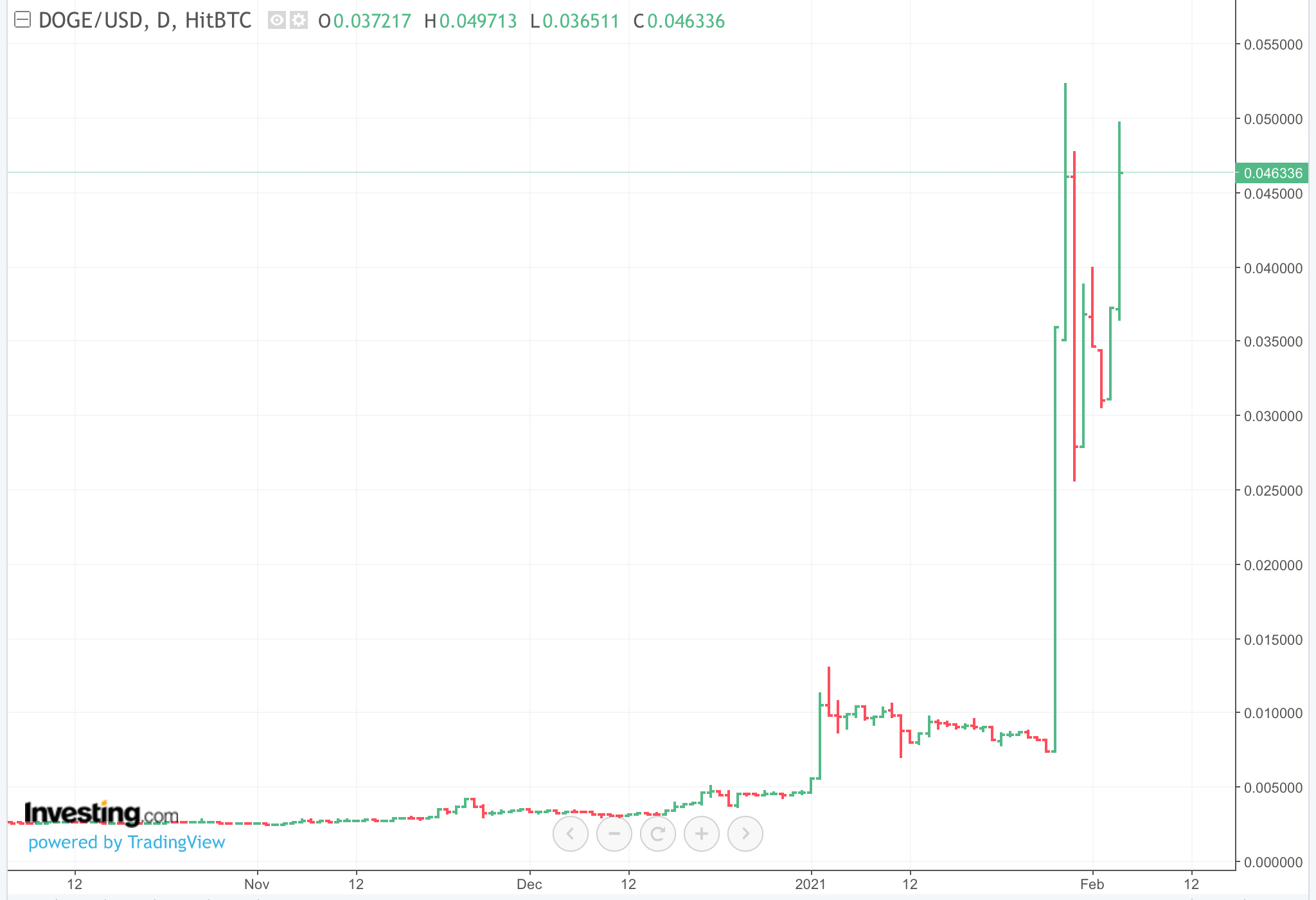
Chart 3

The bubble marker blow-off phenomena are multiplying.  So... fancy a tulip? Good doggy.

Thursday, February 4, 2021

The Market As A Casino

 Continued from yesterday's post...

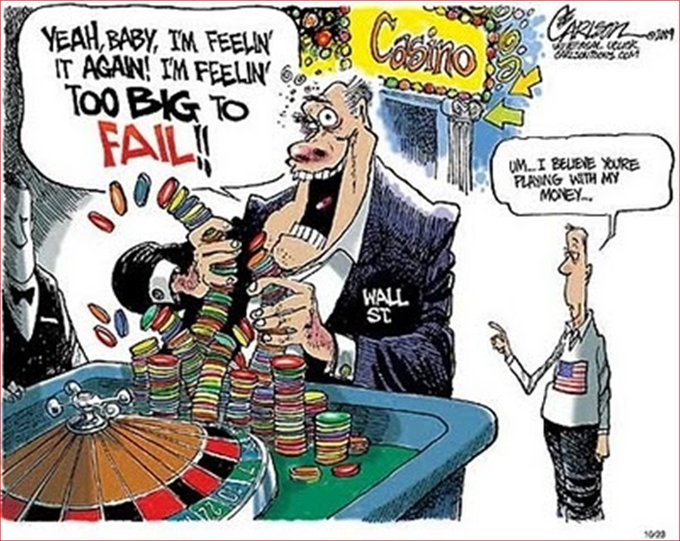
Equity markets in the US have become narrow, shallow and very volatile.  Furthermore, they are highly and dangerously dependent on government/Fed liquidity. Therefore, they are inefficient and can no longer operate as efficient "clearers" for the productive allocation of capital.  They are now more like a casino, and pose a threat to themselves, the public and the economy.

Image

How do we fix them? Here are my suggestions:

  1. Sharply reduce high frequency trading (aka "flash" trading).  The easiest way is to impose a very small transaction tax on each trade, say 0.1%-0.2%.
  2. Ban payments for trade flow.  Right now large firms (eg Citadel) pay for executing other brokers' trades because they can profit from arbitrage,
  3. Ban commission-free trading, at least for retail investors. This may happen anyway if (2) is enacted.
  4.  Ban CFDs and spread betting on all listed and unlisted financial instruments, worldwide. 
  5. Ban all "dark" and "grey" off-exchange equity markets. Easiest way would be to deem any trade done there as legally null and void. Clearers will immediately refuse to clear such trades. 
  6. Increase margin requirements for equity derivatives.
  7. Ban "naked" short selling, re-impose the "uptick" rule on short sales.
  8. Rethink the wholesale automation of trade execution. The total elimination of the "friction" created by people handling trades results in a very "slippery" market environment, one prone to high volatility.
  9. Wean markets from their dependency on Treasury/Fed liquidity.  This is not easy, as money is like water - it will always find a way to flow through the tiniest crack. Perhaps a first step is to stop the Fed buying any corporate securities, domestically and abroad.
 
A final observation: there is way too much money allocated to investment products that automatically track various indexes,currencies, commodities, sectors, sub-sectors or even individual stocks.  Such products, for example Exchange Traded Funds (ETFs), are obligated to trade, no matter what - there is no judgement call, ever.  In the US alone, ETF assets have reached  approx. $6 trillion, almost 30% of GDP,- and 75% of that is in equities. ETFs represent a massive 32% of all equity transaction volume.
 
That's just too much money that MUST trade, no matter what the conditions; such products can act as trend accelerators, up or down, bubble or bust.  Think of them as speeding cars where the gas pedal is always pressed, no matter where they are headed. Transactions are now highly concentrated at the very end of the trading session (Chart 1). More dangerous still, obviously, are those ETFs that promise performance 2x or 3x that of the underlying asset/index. 
 
 
Chart 1

I don't have a suggestion for a fix on this situation, maybe a first step would be a moratorium for all new issues, which reached an all time high of $66  billion in January. There were 19 new ETFs launched in the first 19 days of 2021 alone. 

I will be doing more research on ETFs and SPACs (special purpose acquisition corporations) over the next few days.