Tuesday, June 30, 2020

Proximity Blindness

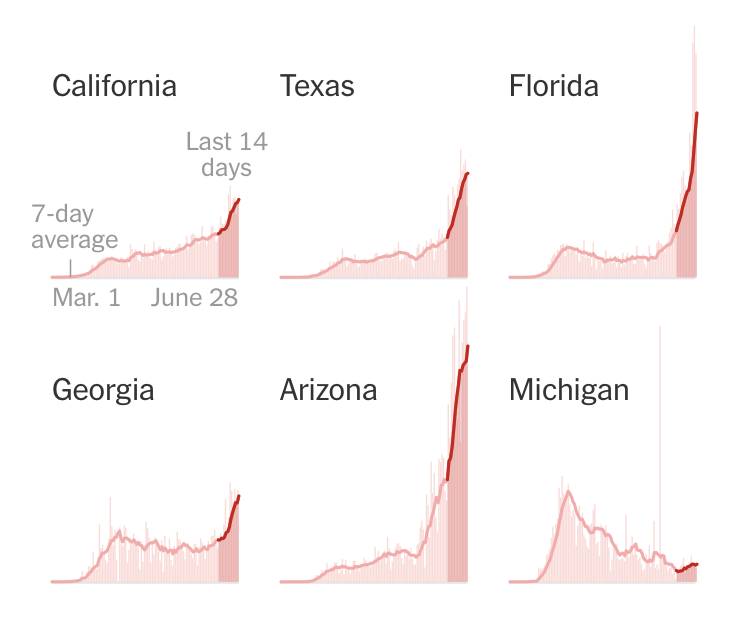
Seven States that are currently experiencing the sharpest rises in new daily COVID cases account for  35.5% of total US GDP:  CA, TX, FL, GA, AZ, LA and SC. Of those, just the first three produce a massive 28.5%.


By comparison,  three of the states which have managed to successfully deal with COVID (so far) are NY, NJ,  CT and produce a combined total of just 13% of GDP.

Yet, that’s where the vast majority of investment bankers, traders, hedge fund managers and  speculators live and work.  IMHO, they cannot but fall prey to a very human proximity blindness, particularly after suffering greatly from the virus.

May partly explain the phenomenal rebound rally.

Monday, June 29, 2020

Reading The Tea Leaves

Charting is an arcane art form 👽 at best and total mumbo  jumbo 👹 at worst.  Yet, it has its uses.  With no further ado, a long term chart of S&P 500 with some annotations.  I won’t add any comment, if you are a practitioner of the “dark arts” you will understand 😆


Friday, June 26, 2020

Something Is Gonna Give

One picture only: NASDAQ and daily new COVID cases in the US are both making new highs.

Something is seriously out of whack here...


Tuesday, June 23, 2020

The Five R’s - Deflation Warning

If nothing else, the coronavirus crisis has accelerated my conviction that our Permagrowth (tm) model is busted.  What’s Permagrowth?  Ever increasing consumer spending in the West on goods made cheaply in the East, all made possible by ever increasing debt. Some call it Globalization, but all it took was one microscopic virus to effectively kill it in a matter of days around the globe.

What is the cure currently used to revive it? More debt, of course, in the form of government bonds purchased (or financed) by central banks, almost exclusively.  The situation is so dire that the most extreme measures are being used.  For example, the ECB pays banks 0.5% to go out and buy government bonds that yield anywhere from 0% to 1.50%.  Yes, that’s right, the ECB lends at negative interest rates, confounding anyone who espouses “neither a lender nor a borrower be.”  In one transaction alone, the ECB is effectively both lender and borrower!! Double the sin, double the fun!!

Now, follow the trade: a bank can go to the ECB, borrow 10 billion euro and receive 50 million annually. It then turns around and buys 10 billion worth of, say, Greek government bonds and receives another 150 million, for a total of 200 million per year.  This is literally free money, produced entirely out of thin air.  No savings needed, no assets, no reserves.. nothing!

Obviously (to me alone??) this is a complete perversion of a proper financial system and a VERY loud alarm bell.  Wake up, folks:  “ Whatever it takes” are NOT soothing words, it’s a cry of desperation.

Anyway, back to the demise of Permagrowth.  I believe we are now seeing its last hurrah, soon to be replaced with something else.  What will that be?  Hopefully, the Five R’s practiced by 8 billion consumers in the following order:
  1. Reject - don’t buy the new “phone” (shoe, watch, app, trinket)
  2. Reduce - one “phone” is enough
  3. Repair - fix the “phone” when it’s damaged, instead of replacing it
  4. Reuse - give the old “phone” to your daughter
  5. Recycle - finally, recycle it


The Five R Economy

The US, EU, China and Japan have a combined GDP of $60 trillion, a whopping 75% of global GDP even though they account for only 30% of global population.  Consumption makes up almost 70% of GDP in the US, 60% in the EU and Japan -  and (just) 43% in China, which exports lots of what the other three consume, taking their IOUs as payment.

Now, when and if Permagrowth is replaced by the 5R’s the effects will be enormous - assuming, of course, that the change will be accomplished peacefully (not a foregone conclusion).  For one, deflation will be prevalent, resulting in sharply lower equity and corporate debt valuations.  Energy sources will not need to be as “dense” as today (oil, natural gas, coal) and could more easily shift to renewables.  The US dollar - petroleum relationship will come apart, leaving the dollar to fend for itself and the US government to seek a much more rational fiscal and monetary policy.

And that’s just for starters... it could get really nasty OR really spectacular out there.  Hopefully, we will all realize our full potential as human beings and choose the latter.

Monday, June 22, 2020

Elections

The Economist has come up with a US Presidential election prediction model which is updated daily. Right now it gives Mr. Biden an 87% chance of winning the electoral college votes.


In my opinion, this projection is completely ignored by the stock market which is focusing (hoping) on a rapid exit from COVID lockdowns, a possible vaccine, etc.  However, I believe that the fiscal policy of the next President is more important than anything else.

According to the Congressional Budget Office the budget deficit will reach $4 trillion this year, some 20% of GDP, or even higher if a second round of  business closures is necessary later on.  Combined with record low corporate tax rates, there is every reason to expect that a Democratic President will seek to repair finances by raising taxes on businesses, particularly those that benefited greatly during the COVID pandemic.

As things stand right now, the risk-reward balance for stocks, particularly the FANG++ types, is heavily skewed towards risk, IMHO. 

Friday, June 19, 2020

Jobless Claims

Initial and continued claims for unemployment benefits is, by far, the best concurrent indicator for the economy’s health.  Both are extremely high and seem to have stabilized at around 10 times higher than their previous levels (see charts below).


Initial Claims For Unemployment Benefits


Continued Claims For Unemployment Benefits

What does this mean?  That even after opening up after the lockdowns, businesses are still laying off a huge number of people and most of them are very weary of rehiring.  In other words, the economy is most certainly NOT currently in a V-shaped recovery.  For comparison, the highest level previously reached for continued claims was 6.8 million during the 2008-09 Debt Crisis, when the most that real GDP dropped was around 3.5%. If claims remain elevated, by this measure alone we’re looking for at least a 10% contraction going forward during 2020/21.

Now, the stock market has already bounced back in V fashion, apparently discounting a faster than ever economic rebound.  Or... is something else happening?  I will use just a single chart to illustrate: Shopify has zoomed almost 300% in just a few days during the pandemic.


Shopify Inc.

The company is currently capitalized at $101 billion, i.e. around 60x REVENUE.  Forget P/E, there are no Es, the company is losing money.

So, what gives?? My thesis is that a few million millennials got a few thousand dollars into their hands and decided to punt with it. What companies do they know and use, which “new ideas” and “new paradigms” do they think they understand better than everyone else, Warren Buffett included?  Why, everything Internet, of course... and wouldn’t you know it, similar chart patterns and nosebleed ratios can be seen across the entire “tech” sector, from Facebook and Amazon all the way to Spotify and Google.  Throw in a religious belief in the Fed as Saviour Of All and you get an enormous bubble..

But, what the millennials clearly do not understand is that the “real” economy is about earned income  (wages) and spending, and more specifically, disposable discretionary income - the part that remains after paying taxes and necessities such as mortgage/rent, food, transport, health, etc.  This is where the economy makes it or falls flat on its face - on the margin, not on the whole.

It does not take a genius to figure out that with a huge number of unemployed, earned income and the propensity to spend on non-essentials is sharply curtailed.  And, yes, it WILL affect the earnings of every company out there, Internet or not.

One more point, learned from decades of experience: in stocks, most money is lost by those who buy on the rebound and not on the initial sharp leg down.  That’s when the sharps unload by the bucket..

Wednesday, June 17, 2020

The Fed To The Market’s Rescue

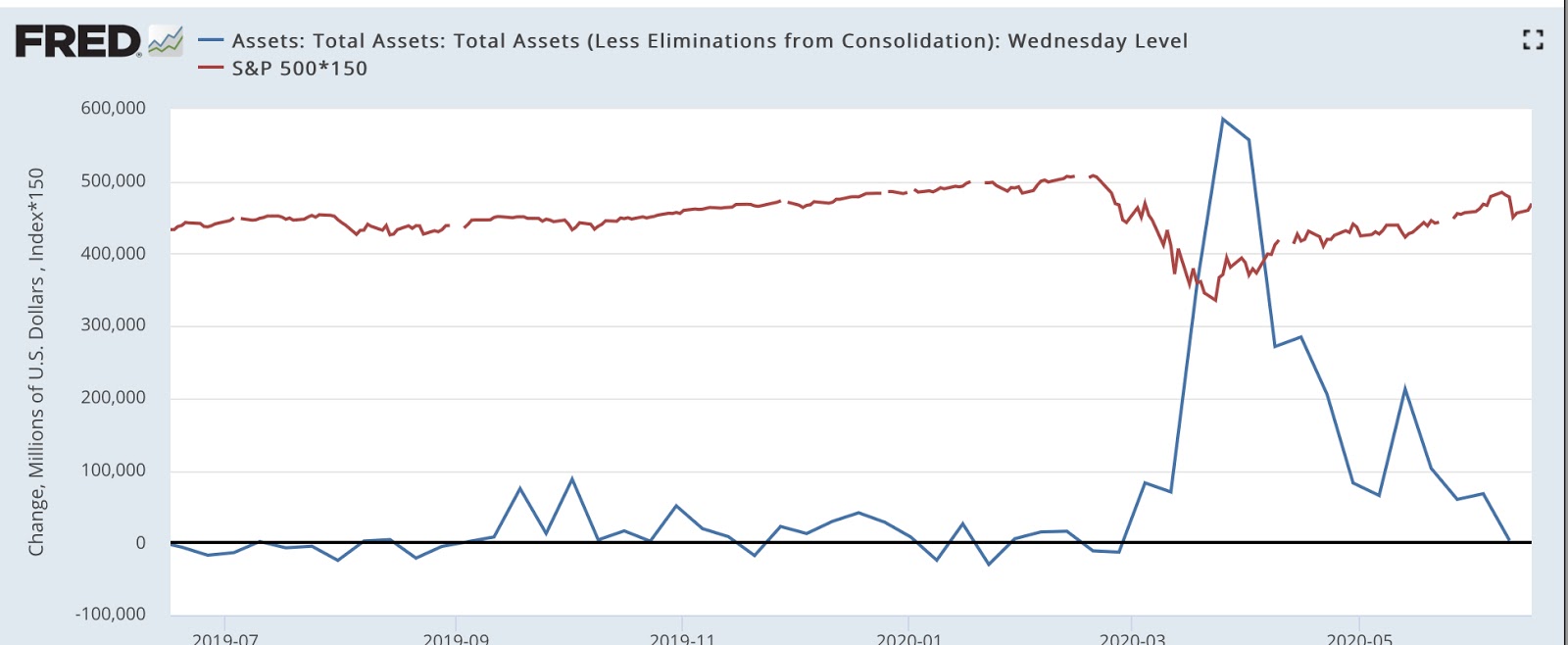
“Never fight the Fed” is one of the oldest and probably most valid adages on Wall Street.  Apparently, it has just been proven true once again as $3 trillion were pumped into the economy in record time.


The Fed’s Balance Sheet Balloons to $7.2 Trillion

The short term correlation between added liquidity and share prices is 100%, as the next chart shows.  The Fed’s weekly injection of huge amounts of money coincided with S&P 500 bottoming out and then sharply rebounding.


Pump It Up 

Now, speculators and investors alike are firmly convinced that the Fed has “put a floor” under the market and will continue doing whatever it takes to keep the market going higher.  Notice, however, that new liquidity injections have now stopped completely.

Unlike what many may believe, the Fed’s stated objective is NOT to support stocks but to safeguard the smooth operation of the banking system and the economy as a whole.  Thus, if there is to be a correction in stock prices do not expect the Fed to intervene - unless it is so sharp and violent that it poses a threat to the system.

That “floor” under the stock market is not made out of stone...

Sunday, June 14, 2020

COVID19 Cases And The Economy

California, Texas and Florida have a combined population of 90 million, almost 30% of the US total. Unfortunately, but certainly not unexpectedly, COVID19 cases are once again rising there, after lockdowns were eased recently.

The dilemma is both simple and morally offensive: do we accept more people falling ill and dying for the sake of economic necessity, or do we re-impose severe social distancing measures?  To an extent, it’s not a 100% binary either/or question, since an economic depression eventually also has serious public health consequences.

Yet, for most people the immediate danger to health is more tangible and real than a statistical blip in mortality rates a couple years down the road.   That’s why I believe that when the current higher cases quickly translate into ICU admissions and, unavoidably, rising fatalities,  there will be great pressure on politicians to reinstitute lockdowns.

The result will be a deeper and more protracted recession, lasting longer than the bubbly financial markets is forecasting right now.


Thursday, June 11, 2020

Wealth Taxes On The Horizon

Not to pat myself on the back, but... ok I will 😆 As I wrote on my June 5 post, soaring costs for COVID19 will eventually lead to higher taxes.  In Britain the wheels are already in motion, according to Reuters, and they are pointed towards the wealthy.


Exclusive: Britain asks private bankers to discuss potential wealth taxes - source
https://reut.rs/30wXJ6r


Wednesday, June 10, 2020

Flight Data

The “real” economy is still very far from recovering, as witnessed by airline passenger data from TSA.  Daily traffic is off the absolute bottom reached in mid-April, but it is still 84% lower than last year.

Meanwhile, stocks have rebounded 100% as they discount a sharp and complete economic rebound in record time.  I remain a sceptic, and I have come up with a historical parallel for this disparity: the dotcom craze of 1999-2000.

Just like 20 years ago, stocks are rising vertically, discounting a future that is way out of touch with the present reality  In other words, it’s all “story” and no fundamentals.  The danger is that even a minor disappointment on how the said story evolves will produce a disproportionately negative effect on share prices.