Friday, April 21, 2023

End Of An Era, Transiting From Permagrowth To Permaflat - Part One

This will be a series of posts on a subject that is of great concern to me as a father: how to create a better, more sustainable world for our children.  I have long thought about starting the series but I kept putting it off.  It is now time to start, no more excuses.

__________________________________________________________________

Back when I was a chemical engineer (it only lasted 2 years after college) I was involved in the design of a corn-to-ethanol plant.  Several such plants were built in the US Corn Belt as a response to the oil crisis in the early 1980s, and were heavily dependent on federal subsidies for gasohol (a blend of gasoline and alcohol).  But it wasn't the economics of the plant which created a lasting impression on me - rather, it was the chemistry/bioprocess itself.

Corn ethanol is produced by fermentation using enzymes, aka yeast, living microorganisms that convert sugars contained in the grain into alcohol. In simple terms, they eat corn and excrete alcohol as their waste.  The process takes place in chemical reactors aptly called "digesters", and it relies on constantly maintaining an optimum balance between healthy enzymes (the critters), corn (their food) and ethanol (their waste).  
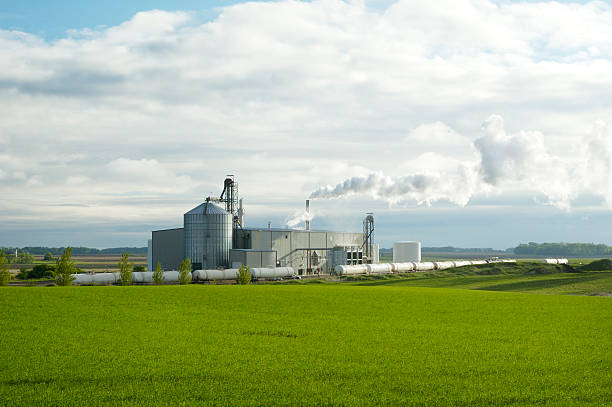

And it has to be a balance because if there is too much food the critters will multiply uncontrollably, produce too much alcohol - which is actually a poison for them -and  will die from exposure to their own waste.  Conversely, if there is too little food they will turn on each other and become critter cannibals. Also, if the fermentation is allowed to run too fast and too hot (it is exothermic) the critters will die off, since they cannot tolerate high temperatures. The trick, therefore, is to introduce food (corn) and extract waste (alcohol + CO2+heat) in a carefully calculated balance to keep the critters healthy and happy.  



Does this sound familiar? 

Of course it does: we humans are the enzymes, the Earth is our reactor vessel and we consume its  resources to fill it with our waste.  But, there is a crucial difference: The Earth is a closed system with limited resources (with the important exception of incoming solar radiation) and no way to extract excess waste/heat. Also, we too are prone to cannibalism (war). 

What's our saving grace? We got critter brains - but even that is a double-edged sword, as we know from the likes of  Caligula, Attila, Hitler, Mao and many more such nasty "critters".  And no matter how smart, at some point the deleterious effects of exponential growth overcome our capacity to deal with them.

Signs of  such a Tipping Point are everywhere: Global warming, climate change, species and habitat  collapse, massive pollution and, very worryingly, a trend towards lifestyle diseases and habits, resulting in poor health and sudden life expectancy drops in wealthy countries like the US.  We even got a global deadly pandemic, a war and “critter arm wrestling” between the world’s two largest critter colonies (US vs China). The alarm bells are ringing, that's for sure.

I think the physical, scientific evidence on the ground is overwhelming.  But what about finance - what is happening there?

This will be the subject of Part Two.

Tuesday, April 11, 2023

Brave New Overleveraged World

 A loyal reader asked a pointed question: is this the worst market mispricing ever? (Thanks AKOC).

Perhaps it is. Why? 

Because the entire global economy is grossly overleveraged on a fundamental basis.  

When we think of markets and leverage we think of margin debt, derivatives, corporate debt, etc.  This was certainly the case in 2007-10 during the Great Debt Crisis, which was "resolved" when the US and EU central banks and governments stepped in and assumed the debt. Private sector debt became government debt, with lots of it sitting in central bank balance sheets. The problem was - literally - papered over.

Then came deflation (thank you China and you cheap manufacturing juggernaut), interest rates went to zero or lower, and for almost a decade everyone forgot that debt carries a servicing cost (interest). Even the worst serial bankrupt in Europe came back and tapped markets for fresh debt (Greece).  It had to mortgage its silverware for 99 years, but.. it did.

COVID changed everything: American, European and Japanese governments panicked and printed money like never before.  They made 2008-10 QE look like a statistical aberration by comparison (see charts below).

United States Federal Reserve  Balance Sheet Assets

European Central Bank Balance Sheet Assets

 
Bank of Japan Balance Sheet Assets

Looking at the charts we can draw only one conclusion: the West is fundamentally extremely overleveraged.  Central banks are financing the economy - take that out and what remains? Let's remember that central banks are regulators and lenders of last resort, not day to day financiers.  By trying to stay in the economic race the West is shooting itself in the foot.

Who is doing things differently?  The second largest economy in the world - China.  Its economy is growing rapidly - yes, it created a real estate lending bubble of its very own in the process - but, in general, it has kept its central bank's nose clean (see chart below).  

Back in 2006-07 I started this blog by posting just a few charts of debt going through the roof. They seemed self evident to me, but it took a couple of years until the doodoo hit the fan.  Today, the first three charts seem just as self evident, so I'll leave it at that.


Monday, April 10, 2023

Are Markets Whistling Past The Graveyard?

 It's the Monday after Easter Sunday and all markets are closed in Europe in deference to Christ's miraculous rise from the dead.  In some ways, then, it's apropos - if a bit sacrilegious - to mention graveyards.

Here's what's been nagging me for a long time now (at least a year): 

  • There's a major war in Europe which keeps escalating. People are using the word "nuclear weapons" with increasing frequency.
  • Tensions between US and China are high and rising.  The proximate cause is Taiwan, but the major issue here is nothing less than global supremacy.
Both of the above are clear and present dangers, and they are here and now.
  • Climate change is accelerating but no one is really doing anything about it in a practical manner.
The latter is forever talked about as a "future" threat, but I'm increasingly worried that the tipping point is much closer than our society thinks.

IMHO markets are completely (and willfully?) ignoring these risks when pricing ALL securities, from bonds and stocks all the way to commodities and derivatives.  I get the feeling that no one in the mainstream is willing to develop a model to take these into account, perhaps fearing that he/she will be branded a loonie.  

How about this model, then?

Pnwu  = Probability of nuclear weapon use(decimal  0.00 - 1.00)   
Pucc    = Probability of USA/China conflict 
Ptp      = Probability of tipping point within 5 years 

Enwu   = Effect of nwu on equity markets  (+/- %)
Eucc    = Effect of ucc on equity markets 
Etp      = Effect of tp on equity markets 

Cumulative Effect = (Pnwu)x(Enwu) + (Pucc)x(Eucc) + (Ptp)x(Etp)

Plug in your own probabilities and likely effects and you'll come up with something a bit more concrete than "um, let's not worry about it right now".

I'm not doing it, they'll call me a loonie -  Well, at least I'm not doing it in public (ha, ha).
 

Friday, April 7, 2023

OPEC+ Was Not Amused

 A week ago OPEC+ (essentially, Saudi Arabia and Russia) announced a wholly unexpected cut in crude oil production and took everyone by surprise.  Prices immediately jumped from $75 to $80 per barrel.  Why did they do it?

I think it was a response to the new round of dollar "printing" by the Fed, engineered to salvage (once again) the US banking system.  How are the two connected? Simple: crude oil is priced in dollars  - when there are immediately more dollars around producers of "hard" goods are encouraged to hike their prices. 

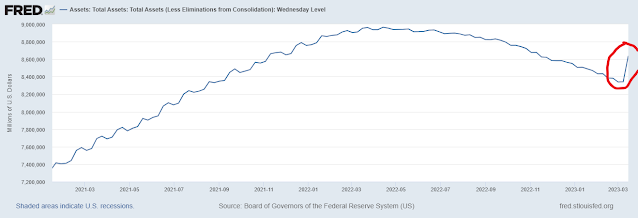
The Fed had started reducing its balance sheet (QT) - but then sharply reversed course and "printed"  overnight as many dollars as it had withdrawn in the last 6 months (QE) - see chart below. And a week later... OPEC+ hiked prices.  I don't know about you, but I don't believe in coincidences.


It seems to me that the negative effects of unwise money creation to the real economy are becoming ever more rapid and obvious, even to the untrained eye.  From another perspective, demand for luxury goods and services by even the merely rich (not to mention the HNW and UHNW) is continuing unabated.  I can speak from personal experience, observing how American tourist bookings abroad are booming, particularly in the luxury sector.  There is just too much money sloshing about and it does not really matter how high interest rates go, until consumer deposit rates go significantly higher than inflation.

Monday, March 27, 2023

The Great Financial Crisis I & II

 Many historians view WWI and WWII as one world war separated by a brief period of peace.  The punitive terms imposed on Germany after WWI directly caused the rise of Adolf Hitler and his Nazis to power and, inevitably, WWII - all in a Europe where WWI had not truly solved the underlying power structure.

Drawing a parallel to the Great Financial Crisis of 2007-10, I believe that the way it was handled by central banks and governments in the US, EU and Japan is now - inevitably - causing the current spate of trouble. Let's call them GFC I and GFC II.

GFC I was "handled" by - literally -  papering it over: Western central banks "printed" enormous amounts of money to save the financial/banking systems in their countries and drove interest rates below zero.  This is a parallel to the punitive terms the Entente Powers imposed upon Germany at the Paris Peace Conference in 1919-20, in the sense that a "sane" financial/economic system cannot long operate under zero/negative interest rates without sowing the seeds of its own destruction.

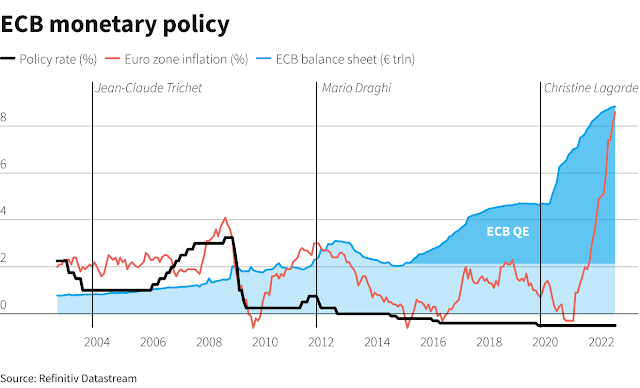
For example, the ECB drove interest rates below zero from 2015 to 2022 (black line in chart below). It was thus only a matter of time and happenstance until inflation soared (red line) when it expanded QE massively during the COVID pandemic.


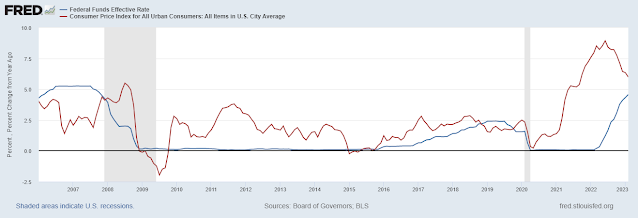
The same happened in the US, though interest rates there never went into negative territory.


And just like WWII was massively more destructive than WWI, GFC II has the potential to wipe out much more than regional banks, or even global systemic banks.  It has the potential of wiping out the public debt of countries like the US and Japan, or even the entire Western financial system.  Unless governments and central banks get really serious in averting the fast rising dangers, we may well become witness to the "Nazification" of our Western economic/financial system.  For example, look at how cryptos are reacting right now..

We really and truly need to act fast and decisively, before the "Nazis" take over:
  1. We must immediately bring inflation down to as close to 2% (maximum) as possible.  There is only one way to do so in a rational manner: QT.
  2. We must immediately eliminate budget deficits and eliminate the need for more public debt.
  3. We must immediately start the process of re-balancing socially unjust income and wealth excesses. 
We must do everything necessary before GFC II starts.  

To draw another parallel from WWI - WWII, it was Winston Churchill, more than anyone else during the interwar period, who warned that Hitler was a dangerous megalomaniac and had to be contained before it was too late.  Instead, Hitler was appeased with disastrous consequences.  Likewise, we cannot afford to let things get out of hand, we must act NOW!


Friday, March 24, 2023

My Shortest Post Ever

 Today I'm gonna go for a record: Hellasious's shortest post ever.

Here goes:

TSIHTF

Hint: It's about global banks

Prize for the first to decipher the "Delphic" initials... free upgrade to Subscriber Status (which doesn't exist, but hey, you never know) ;)


Sunday, March 19, 2023

The Oracle Of Wall Street And The Oracle Of Delphi

 Warren Buffet’s Berkshire Hathaway has 39% of its holdings in Apple shares and another 11% in Bank of America. Thus, a massive 50% is in just two stocks. In my opinion, not exactly a prudent “widows and orphans” investment stand - but who am I to question the Oracle’s judgement?

Instead, I will act like the ancient Oracle of Delphi who was famous for prophesies that could be interpreted any which way: here are charts of Apple and Bank of America. Readers are encouraged to read them as they themselves see fit.


Friday, March 17, 2023

Quantitative Tightening Ends Abruptly, Inflation To Follow

 Well...There goes QT.... In just a couple of days the Fed has pumped back in as much money as it drained in the last 4-5 months. 

Do you think inflation will follow? Unless we go into a full, blown out Crash yes, inflation is going back up ... 


Federal Reserve Balance Sheet Assets Jump Sharply

PS The Fed may flood the system with liquidity if it needs to, but the real problem here is counterparty risk exposure between financial institutions. As many of you may know, the entire global financial system (and thus the global economy) depends on the smooth functioning of the interbank market for foreign exchange, money (ie deposits) and their derivatives. It is, by far, the largest market in the world and depends on “lines” granted by banks to each other, ie how much do they trust each other to fulfill their obligations arising from trading.  Will they deliver on settlement date, will they return the money when due, etc.

When banks’ interbank credit departments get spooked they immediately slash their lines - and when that happens it’s basically all over for the bank whose lines are being cut - it can then only go to the Fed as lender of last resort.

Problem is, when one domino falls it is followed by others. As one bank gets its lines slashed it must do the same with lines it has itself extended to smaller banks, and so on and so forth.  The bigger the bank that gets in trouble the worse the result down the line. For example, Credit Suisse is amongst the 30 largest globally systemic banks in the world.  You can safely bet that it’s counterparties are taking a very serious look at their exposure to it. In fact, I’m pretty darn certain that bank officers are re-examining ALL of their credit lines to all banks right now.


Trying To Stop A Falling Knife - Memories of Crashes Past

Yesterday a team of banks announced that they will deposit $30 billion with Republic First Bank in an attempt to bolster confidence in what is quickly becoming a banking crisis.  Likewise, the Swiss National Bank threw Credit Suisse a lifeline.

My immediate reaction was to remember a parallel from 1929.  

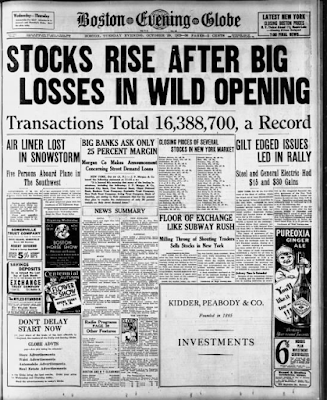
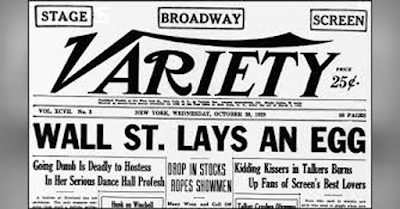
On Thursday October 24, 1929 i.e. a few days before the infamous Crash of Black Monday, the stockmarket was getting pummeled.  A few top bankers decided to stem the bloodbath by getting themselves physically on the floor of the NYSE and making a show of buying stocks: Charles Mitchell from First National City Bank, JP Morgan Jr., Thomas Lamont and Albert Wiggin from Morgan. Indeed, their show of confidence managed to stop the drop, stabilized prices and even created a rebound. But, it was all extremely short lived, as we know.

Why? Because then as now, fundamentals ALWAYS rule the day, eventually.


A Few Days Before The Crash


And Right After


Monday, March 13, 2023

Three Banks Fail, Fed/Treasury Step In - And Save The Day?

The REAL news in the Fed/Treasury moves to shore up deposits in the banks that failed last week is not the Fed/Treasury moves.  The REAL news is that no other bank stepped in to take them over. Think about it... 

Also news is that the cost of saving them will be spread out amongst all other FDIC insured banks for all amounts over $250.000.  That's not going to be chump change, as total deposits for Silicon Valley and Signature come to approx.  $300 billion and FDIC's Insurance Fund balance in the end of 2022 came to $128 billion. Sure, the failed banks' assets will be liquidated to pay out depositors but given the state of the tech and crypto industries... don't expect anything near 100 cents on the dollar for the loans.

Update: First Republic Bank stick is plunging 60% today. With $210 billion in assets, it #14 in size in the US. The dominos refuse to stop falling despite Mr. Biden’s pledge to do whatever is needed.